

Table of Contents
- Start With a Full Purge and Inventory
- How to Fold Fitted Sheets So They Stack Flat
- Pick the Best Linen Closet Storage Bins for Your Space
- How to Store Bamboo Sheet Sets Together
- Build a Realistic Organize Linen Closet System for Large Families
- Small-Space and Closet-Less Solutions
- Maintenance: Keeping Your Linen Closet Tidy Year-Round
- Frequently Asked Questions
Last Updated: September 24, 2026
Start With a Full Purge and Inventory
Learning how to organize your linen closet starts with subtraction, not shopping. Empty every shelf, then sort each item into keep, donate, and rag piles. The purge matters more than the bins: most closets fail because they hold too much, not because they lack containers.
Work through the categories one at a time, and use a real count instead of a gut feeling:
- Sheet sets: Keep two sets per bed in rotation, one on the bed, one clean and waiting. A third set is only worth keeping if you have a guest bed or a child who wets the bed.
- Bath towels: Three towels per person covers a wash cycle comfortably. A family of four needs roughly twelve bath towels, not twenty.
- Washcloths and hand towels: Keep a generous stack; these wear out fastest and get replaced most often.
- Bedding: One duvet cover or blanket per bed, plus one seasonal extra.
A common mistake is keeping stained or pilled linens "for guests" or "for the garage." Those items quietly consume half your shelf space.
Run the math before you decide what stays
Pull everything onto the bed and count. Write the number on a sticky note for each category. Then compare it to what your household actually cycles through in a week. If you own eighteen bath towels but only wash towels once a week for four people, you are storing six towels that never get used. That surplus is the space you are trying to reclaim.
What to do with the linens you remove
- Donate: Clean, unstained sheets and towels in usable condition. Animal shelters, homeless shelters, and veterinary clinics frequently accept towel and blanket donations because they use them for bedding and cleanup. Call ahead, many have specific drop-off hours.
- Rag bin: Torn, stained, or threadbare items you will actually use for cleaning, painting, or car maintenance. Keep this bin small and in the garage, not the linen closet.
- Textile recycling: Most communities have textile drop-off bins or curbside textile collection. Worn-out linens that cannot be donated still get diverted from the landfill. Search your municipal waste services page for "textile recycling" to find the nearest drop-off.
- Upcycle: Flannel sheets make good quilt backing or pet beds. Old towels become car-drying cloths or shop rags. A fitted sheet with a blown elastic can be cut down into a flat sheet for a smaller bed.
Once the purge is done, you should be able to name every item on every shelf. If you cannot, the closet is still holding surplus.
How to Fold Fitted Sheets So They Stack Flat
Fitted sheets stack flat when you fold them into a rectangle before folding them into a square. The elastic corners are the problem, so tuck them inside each other first.
Here is the method that works:
- Hold the sheet inside out and find all four corners.
- Tuck one corner into another, nesting them together. Repeat with the remaining two corners.
- Lay the sheet on a flat surface with the nested corners on top.
- Fold the sides inward so the sheet forms a rough rectangle.
- Fold in thirds, then in half. The result is a flat bundle that stacks without leaning.
Pick the Best Linen Closet Storage Bins for Your Space
The best linen closet storage bins are clear, stackable, and sized to your shelf depth. Clear bins let you see contents without unstacking, and stackable designs use vertical space that open shelves waste.
Match the bin to the job:
| Bin Type | Best For | Watch Out For |
|---|---|---|
| Clear stackable bins | Sheet sets, folded bedding | Cheap plastic cracks in cold rooms |
| Fabric baskets | Towels, washcloths | Holds dust and hides contents |
| Shelf dividers | Keeping stacks upright | Only works on solid shelves |
| Under-shelf baskets | Small items, washcloths | Limits height of items below |
How to Store Bamboo Sheet Sets Together
Storing bamboo sheet sets together means folding the entire set inside one of its own pillowcases. This keeps the fitted sheet, flat sheet, and pillowcases as a single bundle, so you never hunt for a missing piece on laundry day.
The method takes under a minute:
- Fold the fitted sheet, flat sheet, and one pillowcase into flat rectangles.
- Stack them together with the pillowcase on top.
- Slide the whole stack inside the second pillowcase.
- Fold the open end under to close the bundle.
Build a Realistic Organize Linen Closet System for Large Families
A large-family linen closet needs an inventory system, not just neat stacks. When six people cycle through towels and sheets daily, the closet is a supply depot, so treat it like one.
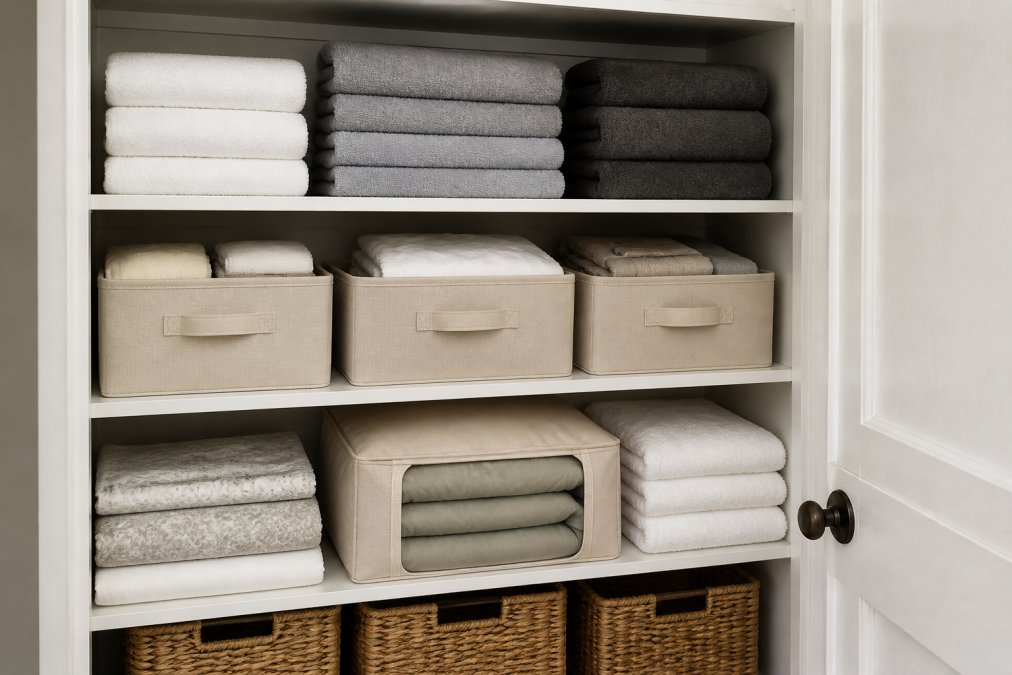
Assign each shelf a purpose and label it
A simple system that holds up under daily use:
- Top shelf: Seasonal bedding and guest linens, out of daily reach.
- Middle shelves: Current sheet sets, one bundle per bed, labeled by size.
- Lower shelves: Bath towels and washcloths, at grabbing height.
- Floor level: Bulk backup, in lidded bins.
Handle multiple bed sizes without mixing them up
This is the part most guides skip. A household with a king, a queen, two twins, and a crib has five different sheet sizes, and a twin fitted sheet looks almost identical to a full when it is folded. Two mechanisms solve it:
- Label by size, not by room. "Queen" and "Twin" beat "Mom's room" and "Kids' room," because beds get swapped and guests use whatever is clean.
- Store each size in its own bin or stack. Never let two sizes share a bin. The five seconds you save by tossing a twin in with the fulls costs you ten minutes of hunting on laundry day.
Set a restock threshold, not a restock feeling
"When the shelf looks low" fails in a busy house because nobody agrees on what low means. Pick a number instead. For a family of six, a workable threshold is:
- Bath towels: When the daily shelf drops below six, run a load. That is one towel per person, which is the point where the next morning gets tight.
- Washcloths: When the stack drops below ten, run a load.
- Sheet sets: When a bed's backup set is in the wash, that bed is on its last set, flag it.
Color-code by person or by bed
Assign each person or bed a towel color. Sorting laundry becomes automatic, and a missing towel is obvious at a glance. Keep the color key on the same card as the thresholds.
Plan for turnover, not just storage
High-volume households burn through linens faster than small ones, so build replacement into the system. When a towel or sheet set retires, note the size and color on a running list. That list becomes your shopping list, and you replace items before the closet runs short instead of after.
Small-Space and Closet-Less Solutions
No linen closet, no problem. Small-space storage works by claiming unused vertical space and converting furniture you already own.
Options that hold real volume:
- Under-bed bins: Flat, lidded containers slide under a bed and hold a full set of bedding per bin.
- Over-the-door racks: The back of a bedroom or bathroom door holds towels and folded sheets on tiered shelves.
- Vacuum-sealed bags: Compress bulky blankets and duvets to a fraction of their height for off-season storage.
- A storage ottoman or bench: Doubles as seating and holds folded linens.
- The top shelf of a bedroom closet: Often empty, and ideal for sheet bundles.
Maintenance: Keeping Your Linen Closet Tidy Year-Round
A linen closet stays tidy when maintenance is a habit, not a project. Five minutes at each seasonal change prevents the slow slide back into chaos.
Build these into your routine:
- Seasonal rotation: Move heavy blankets up and light linens down as the weather shifts.
- One-in, one-out: When a new set enters the closet, an old one leaves.
- A quarterly check: Pull everything forward, wipe the shelves, and re-fold anything that has slumped.
- Retire worn items: Move torn or thinning linens to the rag bin or a textile recycling drop-off rather than back on the shelf.
Frequently Asked Questions
What is the best way to organize a deep linen closet?
Use the back of a deep shelf for items you rarely touch, like holiday guest linens or off-season bedding, and keep daily towels and sheet sets at the front. Shelf dividers and clear storage bins stop stacks from sliding into the void, and a lazy Susan in a deep corner makes washcloths and small items reachable without digging.
Should you store towels and sheets together?
Keep them on separate shelves or in separate bins. Towels shed lint that clings to sheets, and mixing them makes it harder to grab a matching set fast. If space is tight, put towels on the lower shelf and sheets above, so lint falls away from your bedding rather than onto it.
How do you keep a linen closet smelling fresh?
Wash and dry every item completely before it goes on the shelf, since trapped moisture is what causes that musty smell. Leave a small open box of baking soda on a shelf, avoid sealing damp textiles in airtight bins, and rotate stock so nothing sits untouched for months.
How often should you reorganize a linen closet?
Do a quick tidy every season and a full purge once a year. A seasonal rotation pulls heavy blankets forward in fall and light sheets forward in spring, which keeps the closet working for whatever the weather is doing. A yearly inventory also catches worn items before they pile up.
A cluttered linen closet is a daily friction point, but the fix is simpler than most people expect: purge first, fold flat, and give every category a labeled home. Bambusasheets builds bedding designed to make that system easier, from 7-piece bamboo viscose sheet sets with embroidered size indicators to matching storage bags that keep a set together between seasons. Get started with Bambusasheets and turn your linen closet into a space that stays calm, organized, and ready for the next wash day.