

Table of Contents
- Why Sheet Sizes Get Confusing After Washing and Storage
- Standard Bed Sheet Dimensions for Every Mattress Size
- How to Measure Your Mattress Depth and Width
- Fitted Sheet Size Identification: 5 Methods That Work
- How to Tell What Size Bed Sheets Are Without a Tape Measure
- Troubleshooting Loose, Tight, or Bunched Sheets
- Shrinkage, Care, and Keeping Sizes Straight Over Time
- Frequently Asked Questions
Last Updated: September 26, 2026
Why Sheet Sizes Get Confusing After Washing and Storage
Knowing how to tell what size bed sheets are starts with one truth: the tag that told you the size is usually the first thing to fade or disappear. A sheet comes out of the dryer, gets folded into a closet, and six months later it's a mystery.
Standard Bed Sheet Dimensions for Every Mattress Size
Standard bed sheet dimensions follow a predictable pattern. Once you know the numbers, you can estimate size by eye.
| Mattress Size | Mattress Dimensions | Fitted Sheet Pocket Depth | Flat Sheet Size |
|---|---|---|---|
| Twin | 38" x 75" | 12-15" | 66" x 96" |
| Full | 54" x 75" | 12-15" | 81" x 96" |
| Queen | 60" x 80" | 12-16" | 90" x 102" |
| King | 76" x 80" | 12-16" | 108" x 102" |
| California King | 72" x 84" | 12-16" | 108" x 102" |
Twin, Full, Queen, King, and California King at a Glance
The jump from full to queen is the biggest width gap: a full mattress is 54 inches wide, a queen is 60. That six-inch difference is easy to spot once a fitted sheet is stretched over the corners. King and California King are trickiest, both are wide, but a California King is longer and narrower, so a king fitted sheet pulls tight on the sides while the ends sag.
Flat Sheet vs. Fitted Sheet: Why the Numbers Differ
A flat sheet is the rectangular top layer that drapes over you; a fitted sheet has elastic corners that grip the mattress. Flat sheets run larger on purpose so they can tuck under the mattress, a queen flat sheet is roughly 90" x 102", while the queen fitted sheet matches the 60" x 80" mattress.
How to Measure Your Mattress Depth and Width
Measuring your mattress takes about two minutes and saves a lot of guessing. Grab a tape measure:
- Measure width from the left edge to the right edge at the widest point.
- Measure length from the head of the bed to the foot.
- Measure depth by placing the tape at the top corner and running it straight down to where the mattress meets the box spring or frame.
- Add a topper if you use one. A 2-inch topper changes your needed pocket depth.
Fitted Sheet Size Identification: 5 Methods That Work
Fitted sheet size identification comes down to five reliable methods. Use them in order, and you'll rarely need a tape measure.
- Check the corners for a size tag or label. Many brands sew a small tag into a seam. It's often faded but still readable.
- Measure corner to corner. A queen fitted sheet spans about 60" x 80" at the seams.
- Check pocket depth. Deeper pockets usually mean a larger size.
- Look at the elastic band. Wider, reinforced elastic often signals a larger sheet.
- Compare against a known sheet. Lay both flat and match the corners.
Corner-to-Corner Measurement
Lay the fitted sheet flat with the elastic corners pointing up. Measure from one corner seam to the opposite corner seam, repeat on the other axis, and match those numbers to the size chart above. A full fitted sheet measures about 54" x 75"; a queen is 60" x 80".
Elastic Band and Pocket Depth Clues
Pocket depth is the distance from the seam to the bottom edge of the corner. Shallow pockets (under 12 inches) usually fit twin and full mattresses; deep pockets (14 inches and up) are built for queen, king, and California king beds, especially those with toppers. Run your fingers along the elastic, if it feels loose, the sheet has likely seen a lot of washes.
How to Tell What Size Bed Sheets Are Without a Tape Measure
Most people reach for a tape measure when they should use their eyes and hands. A fitted sheet carries several built-in clues, and once you know the order to check them in, you can sort a pile of loose sheets in about a minute.
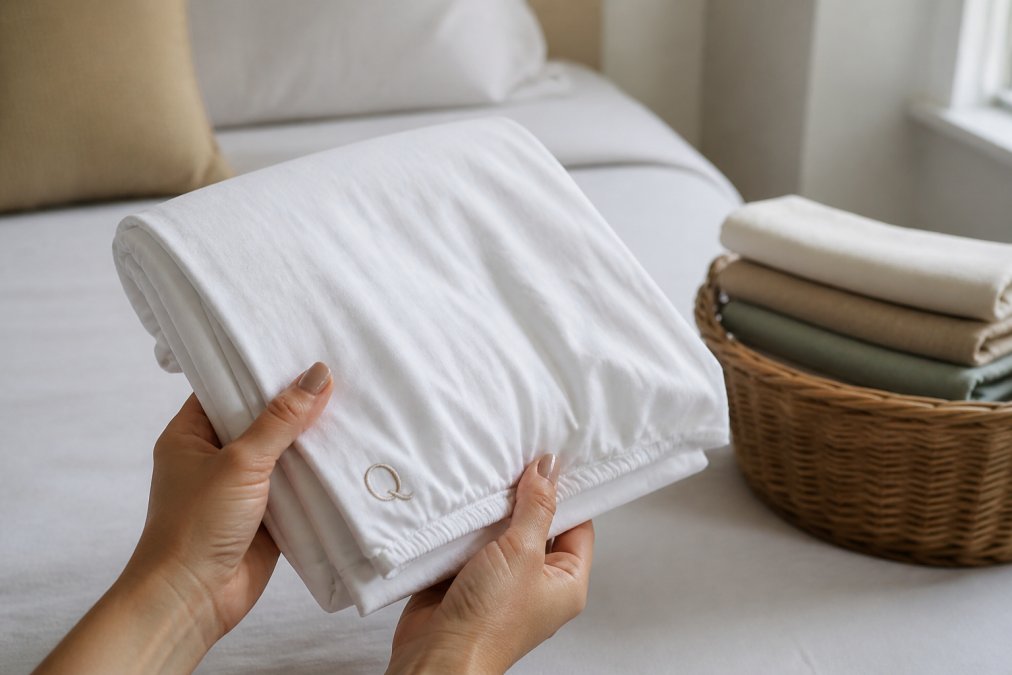
Step 1: Check the Bottom Corners for an Embroidered Letter
The single fastest method is also the one most people never look for. Some sheet sets embroider a size letter directly onto the fabric at the bottom corners of both the fitted and flat sheet. On Bambusa Sheets, that letter reads K for King, Q for Queen, and F for Full.

- Identification. You don't need to unfold, measure, or compare anything. Flip the corner over, read the letter, done.
- Orientation. Because the label sits on the bottom corner, it tells you which end goes at the foot of the bed, the part people get wrong most often. A fitted sheet rotated 90 degrees will fight the mattress even when it's the correct size.
Step 2: Compare the Two Sheets in the Set
If there's no letter, compare the fitted sheet against the flat sheet from the same set. The flat sheet is always the larger rectangle, so the fitted sheet is your size reference. Lay it flat with the elastic corners up:
- A Full fitted sheet is noticeably squarer, roughly 54" wide by 75" long.
- A Queen fitted sheet is wider than it is long by a smaller margin, about 60" by 80".
- A King fitted sheet is the widest of the three at roughly 76" by 80", and it looks almost square when laid out.
Step 3: Use the Pillowcase Count as a Tiebreaker
Pillowcase count is a quick secondary signal. Twin and Full sets typically ship with two pillowcases, while Queen and King sets usually include more, Bambusa sheet sets include four pillowcases, a fast hint that you're holding a larger set. Combined with a corner check, it narrows things down fast.
Step 4: Fold-and-Stack Comparison
When you have several sheets of unknown size, fold each the same way, in half, then in half again, and stack them. Folded identically, a King is the widest rectangle, a Queen next, and a Full the narrowest.
Step 5: The Arm Span Test (Last Resort)
If you have nothing else to go on, your arm span is a rough ruler. An average adult's outstretched arm span is close to their height (Checking your browser), so a Twin or Full sheet is narrower than most people's reach while a King is wider. Treat this as a gut-check only, it can't reliably distinguish a Queen from a King.
Troubleshooting Loose, Tight, or Bunched Sheets
A fitted sheet that won't behave almost always has one of four root causes. Diagnose which one before you spend money on a fix.
Symptom 1: Corners Pop Off During the Night
Most likely cause: pocket depth is too shallow for your mattress.
Fixes, in order of preference:
- Switch to a deep-pocket fitted sheet sized for your mattress depth.
- Add corner clips or a fitted-sheet fastener strap that runs under the mattress and connects opposite corners.
- Add sheet suspenders, elastic straps that clip to two corners and pull them toward each other underneath the bed.
Symptom 2: The Sheet Bunches in the Middle
Most likely cause: the sheet is one size too large.
Symptom 3: The Sheet Feels Tight and Short
Most likely cause: shrinkage after washing.
Natural-fiber sheets can shrink slightly over the first few washes, and heat accelerates it. A sheet that fit perfectly out of the packaging can feel snug two months later, normal, not a defect, but worth accounting for.
Fixes:
- Wash in cold water on a gentle cycle.
- Tumble dry on low heat, or air dry.
- Skip high-heat drying and bleach, both of which stress fibers.
- When buying new, look for fabric that's been pre-shrunk so the fit you get out of the bag is the fit you keep.
Symptom 4: The Elastic Feels Slack or Wavy
Most likely cause: age and repeated washing have relaxed the elastic.
A Quick Diagnostic Table
| What you're seeing | Root cause | First thing to try |
|---|---|---|
| Corners pop off nightly | Pocket depth too shallow | Deep-pocket sheet or corner clips |
| Sheet bunches in the center | Sheet is a size too large | Confirm size via corner letter |
| Sheet feels tight and short | Shrinkage after washing | Cold wash, low-heat dry |
| Elastic feels slack | Age and repeated washing | Replace the set |
| Sheet fits but sits sideways | Wrong orientation | Check the bottom-corner label |
The Orientation Problem Nobody Talks About
Sometimes the sheet is the right size and still fits badly, because it's rotated. A fitted sheet placed sideways on a rectangular mattress pulls tight on two sides and sags on the other two, which feels exactly like a sizing problem. This is where a bottom-corner label earns its keep: the embroidered letter sits on the bottom corner, telling you which end goes at the foot of the bed so you position the sheet correctly the first time.
Shrinkage, Care, and Keeping Sizes Straight Over Time
Shrinkage is the silent size-changer. Most natural-fiber sheets shrink a little in the first few washes, and heat speeds that up.
To keep sizes accurate over time:
- Wash in cold water on a gentle cycle
- Tumble dry on low heat, or air dry
- Skip bleach and fabric softener
- Store each set with its matching pillowcases
- Fold sets together so sizes stay paired
Frequently Asked Questions
How can I tell the difference between a full and queen fitted sheet?
A full fitted sheet measures about 54 by 75 inches, while a queen measures about 60 by 80 inches. Lay both flat and compare: the queen will be roughly six inches wider and five inches longer. If you cannot measure, fold each sheet into quarters and stack them; the queen will extend past the full on two sides. Checking corner labels, like the embroidered F or Q on Bambusasheets, is the fastest way to confirm without any measuring.
Is there a quick way to identify sheet sizes without measuring?
Yes. Check the bottom corners of the fitted sheet for embroidered or printed size letters. Bambusasheets embroiders K, Q, or F directly on the bottom corners of both the fitted and flat sheets, so you can identify the size and the correct direction in seconds. If your sheets have no labels, try the pillowcase test: a king pillowcase is noticeably longer than a queen or standard one, which narrows down the set.
What is the standard size for bed sheets?
Standard bed sheet dimensions in the U.S. follow mattress sizes: twin is 38 by 75 inches, full is 54 by 75 inches, queen is 60 by 80 inches, king is 76 by 80 inches, and California king is 72 by 84 inches. Fitted sheets add pocket depth, usually 12 to 18 inches, to accommodate mattress height. Flat sheets run larger than the mattress so they can tuck under. Always match the sheet size to your mattress size, not the other way around.
Why is it difficult to identify sheet sizes after washing?
Washing causes fabric shrinkage, especially in cotton and cotton blends, so a queen sheet that started at 60 by 80 inches may shrink by an inch or two. Tags fade or fall off, and once sheets are folded and stacked in a linen closet, visual differences blur. Bamboo viscose sheets like Bambusasheets tend to hold their shape well, and the embroidered corner letters stay readable through repeated wash cycles, which solves the identification problem long term.
Sorting sheets shouldn't feel like a puzzle. Bambusasheets makes it simple with embroidered size indicators on the bottom corners of both the fitted and flat sheets, so you can spot K, Q, or F at a glance and position each sheet correctly the first time. Every 7-piece bamboo viscose set also includes four pillowcases and a storage bag to keep everything paired. Get started with Bambusasheets and make every bed-making session faster and easier.