

Table of Contents
- Why Fitted Sheets Slip and Bunch Overnight
- Quick Fixes to Keep Fitted Sheets From Sliding
- Best Sheet Fasteners for Deep Mattresses
- How to Fix Loose Fitted Sheet Elastic
- Fabric and Fit: Choosing Sheets That Stay Put
- How to Wash Bamboo Sheets Correctly
- Final Thoughts on a Secure, Wrinkle-Free Bed
- Frequently Asked Questions
Last Updated: September 7, 2026
Few things ruin a good night's sleep like waking up on a bare mattress pad with your fitted sheet bunched at the foot of the bed. If you've been searching for how to keep fitted sheets from sliding, the problem is rarely the sheet itself. It usually comes down to a mismatch between mattress depth, elastic quality, and fabric friction against your topper. The fixes below range from two-minute hacks to permanent upgrades.
The key insight: a fitted sheet slides because the elastic no longer grips the full depth of your mattress. Once you measure correctly and match pocket depth, most slipping stops.
Why Fitted Sheets Slip and Bunch Overnight
Fitted sheets slip when the tension holding them to the mattress fails. The elastic band pulls the fabric taut, but that tension weakens as the band stretches out or when the pocket depth is too shallow for your mattress.
Modern mattresses are thicker than they used to be. Add a 2-inch topper, and a standard 12-inch pocket sheet suddenly has to cover 14 inches. The sheet rests on top rather than wrapping underneath, so any movement pulls it loose.
Fabric friction also plays a role. Smooth, tightly woven sheets slide against slick mattress protectors more easily than textured cotton percale. Silkier weaves like sateen feel wonderful but offer less grip below.
Quick Fixes to Keep Fitted Sheets From Sliding
Before buying any accessories, try these immediate fixes that cost nothing and take under five minutes:
- Recheck your corner placement. Lift each mattress corner and pull the sheet pocket fully over the edge. A sheet that looks fitted often sits only halfway down the corner.
- Smooth the mattress pad. Wrinkles and folds in your topper create a slippery, uneven surface. Smooth it completely before laying the sheet.
- Tuck the excess under the head. For standard mattresses, fold the sheet's top edge under the head of the mattress for extra anchor points.
- Use a mattress topper with a fitted skirt. If your topper has its own elastic skirt, it creates a grippier base layer than a flat pad.
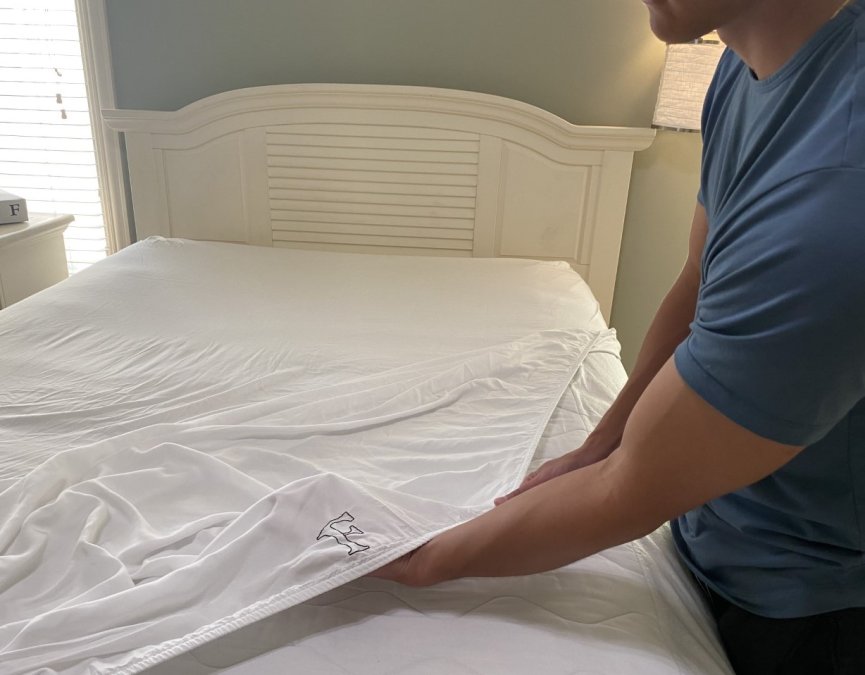
A person's hand tucking a deep pocket fitted sheet corner securely under a mattress in a bright, modern bedroom with natural light from a nearby window
These fixes resolve roughly half of slipping cases by restoring the sheet's contact with the mattress sides. If your sheet still pops off within a night or two, you need a mechanical solution.
Best Sheet Fasteners for Deep Mattresses
For deep mattresses measuring 14 inches or more, the best fasteners are heavy-duty suspender clips that run diagonally across the underside of the mattress. These straps clip onto the sheet's hem at opposing corners and pull downward, maintaining constant tension all night.
The market offers three main types of fasteners, each suited to a different situation:
Fastener Type |
Best For |
Installation Time |
Durability |
|---|---|---|---|
Sheet suspenders with clips |
Deep mattresses, restless sleepers |
5 minutes |
High |
Corner grippers |
Mild slipping, standard mattresses |
2 minutes |
Medium |
Adjustable strap sets |
Heavy-duty anchoring |
10 minutes |
High |
Sheet suspenders are the most reliable option for deep mattresses. They consist of elastic straps with clips at each end that attach to the sheet hem and stretch diagonally from one corner of the mattress bottom to the other, distributing tension evenly.
Corner grippers work well for mild slipping. These Y-shaped straps wrap around each corner, holding the sheet's pocket tightly against the mattress edge. They are simpler to install but provide less tension than full suspenders.
How to Fix Loose Fitted Sheet Elastic
Elastic degradation is a mechanical failure. The band inside your sheet's hem is made of rubber or spandex fibers wrapped in a polyester or cotton sheath. Over time, the rubber oxidizes and loses resilience, and the sheath stretches out. Heat accelerates both. A typical elastic loses about 30% of its tension after 50 wash-dry cycles at high heat (peer-reviewed research).
Diagnose Before You Repair
Before you sew anything, determine whether the elastic is truly dead or just tired. Perform the pinch test: lift the sheet corner, pinch the elastic band, and pull it away from the fabric. If it snaps back immediately, the elastic is fine. If it stays stretched or returns slowly, it has lost its recovery.
A second test: lay the sheet flat and look at the hem. If the elastic is visible through the fabric or has created a wavy, puckered line, the sheath has stretched out even if the elastic inside is intact. Replacing the elastic is the only fix.
The Full Replacement Method
Replacing the elastic is a 30-minute job with a sewing machine, or an hour by hand:
- Unpick one corner seam where the elastic ends meet. Use a seam ripper to open a 2-inch section of the hem casing.
- Extract the old elastic. Pull it out through the opening. You may need to unpick a second corner if the elastic is sewn in multiple places.
- Measure the new elastic. Cut a piece of 1/4-inch or 3/8-inch non-roll elastic to the full perimeter of the sheet, then cut it 10-15% shorter. For a queen sheet with a 240-inch perimeter, cut the elastic to about 210 inches. This pre-tension ensures a snug fit.
- Thread the new elastic through the hem casing using a safety pin. Work it around the full perimeter. Go slowly to avoid twisting the elastic inside the casing.
- Overlap the ends by 1 inch and stitch them together with a zigzag stitch. Do not use a straight stitch; it will pop under tension.
- Close the casing with a straight stitch, then reinforce with a second pass.
The Topper-Specific Fix
If you use a mattress topper, the problem is often not the elastic itself but the added height. A sheet with good elastic on a bare mattress will fail when you add a 2-inch topper because the elastic now has to stretch further to reach the underside. The fix is adding an extension, not replacing the elastic.
Sew a 4-inch strip of elastic onto each corner of the sheet, creating a loop that hooks around the mattress corner. Attach the strip to the inside of the existing elastic hem at each corner, forming a Y-shape that wraps under the mattress corner. This adds 4 inches of reach and restores tension without replacing the entire band.
When to Replace the Sheet
If the fabric itself has stretched out, not just the elastic, no repair will help. A sheet that has lost its dimensional stability will bag and wrinkle even with new elastic. Test this by pulling the fabric diagonally from corner to corner. If it stretches and does not recover, the fibers have broken down. Replace the sheet.
A Note on Elastic Quality
Not all elastic is equal. The elastic in a $30 sheet set is typically low-grade rubber that degrades in 12-18 months. Higher-end sheets use spandex or elastane blends that last 3-5 years. When you repair a sheet, buy elastic with a high spandex content (at least 20%) rather than cheap rubber.
Fabric and Fit: Choosing Sheets That Stay Put
Most guides stop at "buy deep pockets," but the real culprit behind sliding sheets is often the friction pairing between your sheet's weave and your mattress surface. A sheet that stays put on a cotton pad may slide right off a slick, waterproof protector. Here is how to match fabric to your setup.
Friction by Fiber and Weave
Cotton Percale: This is the grippiest common weave. The matte, crisp finish creates high surface friction against most pads and toppers. If you sleep hot and move around, percale is the most forgiving choice for keeping sheets anchored.
Cotton Sateen: Sateen's smooth, lustrous surface comes from a higher thread count and a weave that exposes more threads to the surface. That silkiness feels great but reduces friction. On a smooth protector, a sateen sheet will slide more readily. If you prefer sateen, pair it with a textured cotton or wool topper, not a slick synthetic one.
Bamboo Viscose: Bamboo viscose is a middle-ground option. The fiber is smooth, but the fabric's natural stretch and recovery create a "hug" effect around the mattress corners, compensating for lower surface friction. The key is that it must have a high elastane content (typically 5-10%) to maintain that recovery. A 100% bamboo sheet with no stretch will behave like a slippery rayon sheet.
Silk and Satin: These are the worst offenders for sliding. Their low friction coefficient means they will shift with almost any movement. If you sleep on silk or satin, you cannot rely on fabric grip alone. You must use a mechanical fastener (suspenders or corner straps) or place a textured cotton fitted sheet underneath as a base layer.
Flannel: Flannel's brushed surface provides excellent grip. The nap catches on mattress fibers, making it one of the most slip-resistant options for winter. The trade-off is heat retention.
The Topper Factor
Your mattress topper is the second half of the friction equation. A quilted cotton topper provides a high-friction surface. A memory foam topper with a smooth, stretchy cover is low-friction. A waterproof vinyl or polyurethane protector is the lowest-friction surface of all.
If you use a waterproof protector, your sheet has almost nothing to grip. Choose a percale sheet or use suspenders. Do not expect a sateen or bamboo sheet to stay put on a vinyl protector without mechanical help.
The 2-Inch Rule and Beyond
Pocket depth must exceed your total mattress height by at least 2 inches, including any topper (sleepfoundation.org). A 12-inch mattress with a 2-inch topper needs a 14-inch pocket minimum, but a 16-inch pocket is safer. The extra material allows the elastic to wrap fully under the mattress and grip the underside, not just strain at the edge.
Measure your mattress with the topper on, not off. Most people measure the bare mattress and then add a topper, which pushes the sheet's pocket to its limit. Measure the full stack, then add 2 inches.
A Note on Thread Count
Higher thread count does not mean better grip. High thread count sateen sheets (600+ count) are often the slipperiest because the dense weave creates a smoother surface. A 200-400 thread count percale sheet will grip better than a 1000-count sateen. Do not shop for grip by thread count alone; shop by weave.
How to Wash Bamboo Sheets Correctly
Your washing routine directly affects how well your sheets grip the mattress. Bamboo viscose sheets, in particular, require specific care to maintain their stretch and fit.
Wash bamboo sheets in cold water on a gentle cycle (goodhousekeeping.com). Hot water breaks down elastic fibers faster, causing the sheet to lose its snap within months. Use a mild liquid detergent free of bleach and fabric softeners, which coat fibers and reduce natural friction, making the sheet slide more easily.
Dry bamboo sheets on low heat or hang them to dry. High heat shrinks bamboo viscose unevenly and damages the elastic band. Line drying extends the life of both the fabric and the elastic significantly.
If your sheets have become slightly loose after washing, a warm-water wash followed by low-heat drying can restore some snugness through gentle shrinkage. This works only for sheets that have stretched, not for those with permanently damaged elastic.
Final Thoughts on a Secure, Wrinkle-Free Bed
A fitted sheet that stays put comes down to three things: correct pocket depth, quality elastic, and fabric with natural grip. Start by measuring your mattress, apply the quick fixes for immediate relief, and invest in suspenders if you have a deep mattress or topper. Wash your sheets properly to protect the elastic, and replace the band when it loses its snap.
For sleepers who move around at night, a bamboo viscose sheet set offers the combination of natural stretch and a smooth, cooling surface that resists bunching. The embroidered size indicators on Bambusasheets sets also assist with correct orientation, helping the sheet sit evenly from the start.
Frequently Asked Questions
Why do my fitted sheets keep slipping off my bed?
Fitted sheets usually slip because the elastic band has lost its tension or the pocket depth is too shallow for your mattress. Measure your mattress height first. Standard sheets fit mattresses up to 12 inches deep, while deep pocket sheets handle 15 inches or more. If the elastic is still snug but the sheet pops off, the fabric may be too slippery for your mattress surface. Adding a mattress pad or using sheet fasteners can bridge that gap.
Are sheet suspenders effective for deep mattresses?
Yes, sheet suspenders are often the most reliable fix for deep mattresses. Look for heavy-duty clips and adjustable straps that can stretch to fit mattress depths of 18 inches or more. The best sheet fasteners for deep mattresses use strong metal or reinforced plastic clips that grip the sheet hem without tearing it. Attach one clip to the sheet's center edge and the other under the mattress corner for a diagonal pull that holds tight.
What kind of sheets won't slide off my bed?
Sheets made from bamboo viscose with a sateen weave offer more friction against your mattress than slippery synthetics like microfiber. Look for deep pocket sheets with strong, elasticized hems that wrap fully around the mattress corner. Bamboo sheets are naturally breathable and their long fibers are durable, which can help maintain a secure fit wash after wash.
How do I fix a fitted sheet that has lost its stretch?
You can restore grip by sewing new elastic into the hem. Turn the sheet inside out and remove the old elastic band. Cut a new piece of elastic about two-thirds the length of the sheet's perimeter. Thread it through the hem using a safety pin, then sew the ends together securely. If sewing is not an option, use sheet fasteners or clips as an immediate solution to hold the loose fabric tight against the mattress.