

Table of Contents
- Why Identifying Fitted Sheet Size Matters
- How to Measure Mattress Depth for Sheets
- Fitted Sheet Size Chart: Matching Dimensions to Your Bed
- How to Identify Fitted Sheet Size Without Unfolding
- How to Label Bed Sheets for Storage
- How to Wash Bamboo Sheets Correctly
-
Common Mistakes When Identifying Fitted Sheet Size
- Mistake 1: Measuring the bare mattress instead of the sleeping surface
- Mistake 2: Ignoring pocket depth in favor of mattress size
- Mistake 3: Forgetting that sheets shrink
- Mistake 4: Trusting the packaging or the storage pile
- Mistake 5: Confusing flat and fitted sheets in a hurry
- Mistake 6: Assuming all queen sheets are cut the same
- Conclusion
- Frequently Asked Questions
Last Updated: September 17, 2026
Why Identifying Fitted Sheet Size Matters
Knowing how to identify fitted sheet size saves you from the most annoying laundry-room problem: a beautifully folded sheet that fits nothing in your house.
How to Measure Mattress Depth for Sheets
Mattress depth is the measurement from the top surface of your mattress to the bottom edge, and it determines what pocket depth your fitted sheet needs.
Grab a tape measure and check three things:
- Width: side to side across the mattress top
- Length: head to foot across the mattress top
- Depth: top surface down to where the mattress meets the foundation
Fitted Sheet Size Chart: Matching Dimensions to Your Bed
Match your mattress dimensions to the chart below, then confirm the sheet's pocket depth clears your mattress height.
| Mattress Size | Dimensions (W x L) | Typical Depth | Fitted Sheet Pocket Depth Needed |
|---|---|---|---|
| Twin | 38" x 75" | 8-10" | 10-12" |
| Twin XL | 38" x 80" | 8-10" | 10-12" |
| Full | 54" x 75" | 9-12" | 12-14" |
| Queen | 60" x 80" | 9-12" | 12-14" |
| King | 76" x 80" | 9-12" | 12-14" |
| California King | 72" x 84" | 9-12" | 12-14" |
| Crib | 28" x 52" | 5-6" | 6-8" |
How to Identify Fitted Sheet Size Without Unfolding
You can identify most fitted sheets without unfolding them by decoding three things in order: the corner tag, the elastic geometry, and the folded footprint.

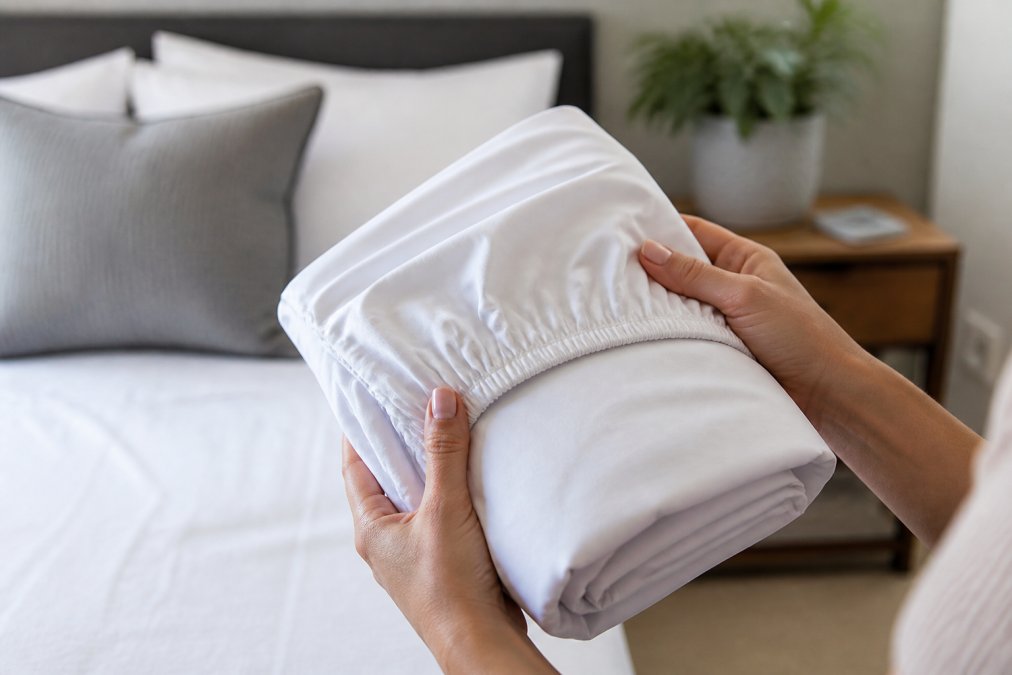
Step 1: Decode the corner tag
Almost every fitted sheet sold in the U.S. carries a size indicator sewn into one of the two bottom corners, the corners that tuck at the foot of the bed. Look for:
- Woven or printed care tags with a size letter: T (twin), TXL (twin XL), F or D (full/double), Q (queen), K (king), CK (California king).
- Embroidered corner letters stitched directly into the fabric, which survive hundreds of washes better than printed tags.
- Color-coded stitching or piping on the corner seam, some manufacturers use a different thread color per size so housekeeping staff can sort without reading.
- A single-letter stamp inside the elastic channel, visible when you stretch the corner flat.
Step 2: Read the elastic geometry
A fitted sheet's elastic tells you its size class before you unfold anything:

- Elastic all the way around (continuous) is standard on most queen, king, and California king sheets because the longer perimeter needs grip along the sides, not just the corners.
- Elastic only at the four corners is common on twin, twin XL, and full sheets, where the shorter perimeter holds fine with corner-only grip.
- A deep, wide elastic band (often 1 inch or more) signals a deep-pocket sheet built for mattresses over 12 inches.
- A thin, narrow band usually means a standard-pocket sheet for mattresses 8 to 10 inches deep.
Step 3: Measure the folded footprint
This is the tiebreaker when the tag is gone and the elastic is ambiguous. Fold the sheet in half along its length, then in half again, and measure the resulting rectangle:
| Folded width (approx.) | Likely size |
|---|---|
| 19" | Twin |
| 19" (longer fold) | Twin XL |
| 27" | Full |
| 30" | Queen |
| 38" | King |
| 36" | California king |
Step 4: Check the hem profile
Flat sheets carry a wide, decorative top hem, often 4 inches or more. Fitted sheets have a narrow, uniform hem all the way around, usually under 1 inch, because the elastic channel does the work. A wide hem on one edge and narrow on the other three means you're holding a flat sheet.
The shrinkage factor nobody mentions
A fitted sheet that measured queen when new may not after two years of washing. Cotton and bamboo viscose both shrink slightly with heat, and elastic loses recovery over time, a 14-inch pocket depth can effectively drop to 12 inches after repeated hot-water washes and high-heat drying.
Commercial versus residential sizing
Sheets sold for hospitality use, hotels, dormitories, short-term rentals, sometimes follow different dimension conventions than retail sheets, running a half-inch to an inch tighter or looser than a retail queen. If you inherit sheets from a hotel or rental, measure the folded footprint and pocket depth before trusting the label.
How to Label Bed Sheets for Storage
Labeling sheets the moment they come out of the dryer prevents the mystery pile from forming. The best systems take under a minute per set.
Try one of these:
Organic Bamboo Cooling Sheet Set →
- Corner letters: If your sheets already have embroidered size indicators, you're done. Fold and stack.
- Storage bags: Keep each set in its own labeled bag. A full-size storage bag keeps the set together and the size visible.
- Index cards: Write the size and bed location on a card, then tuck it inside the folded set.
- Basket system: Assign one labeled basket per bed size. Everything goes back to its basket, always.
How to Wash Bamboo Sheets Correctly
Bamboo viscose sheets need cooler water and lower heat than cotton to protect softness and fit.
Common Mistakes When Identifying Fitted Sheet Size
The most common mistake is assuming queen and full sheets are interchangeable because they share a 75-inch length. They are not, the 6-inch width gap shows up the moment you tuck a corner. Here are the errors that cost people a return trip.
Mistake 1: Measuring the bare mattress instead of the sleeping surface
A mattress topper adds height the fitted sheet must clear. A 2-inch memory foam topper turns a 10-inch mattress into a 12-inch profile, and a 12-inch pocket sheet that fit before now pulls free at the corners. Always measure with the topper in place, at all four corners.
Mistake 2: Ignoring pocket depth in favor of mattress size
Mattress size (queen, king) tells you the footprint; pocket depth tells you whether the sheet stays on. Buying by size alone is how people end up with a queen sheet that fits a queen mattress but pops off every night. Check both: the footprint must match, and the pocket depth must exceed mattress height by at least 1 to 2 inches.

Mistake 3: Forgetting that sheets shrink
Natural fibers and bamboo viscose shrink slightly over time, and heat accelerates it. A sheet washed hot and dried on high heat loses elastic recovery faster than one washed cold and dried low. The tag still says queen, but effective pocket depth may have dropped an inch or more. If a sheet that used to fit now slips, shrinkage is usually the cause.
Mistake 4: Trusting the packaging or the storage pile
Sets get mixed up in storage, and packaging gets separated from the sheet it came with. A queen fitted sheet folded into a king package looks identical until you make the bed. Verify the corner tag or folded footprint before you commit, especially with guest-room, rental, or hand-me-down sheets.
Mistake 5: Confusing flat and fitted sheets in a hurry
A flat sheet has four straight, unelasticized edges and a wide decorative top hem; a fitted sheet has gathered, stretchy corners and a narrow uniform hem. In a dim closet, a folded flat sheet can look like a fitted one until you feel the edge, run your thumb along it, and if it does not gather, it is flat.
Mistake 6: Assuming all queen sheets are cut the same
Retail queen sheets vary by manufacturer, and hospitality-grade sheets sometimes follow different dimension conventions. A queen from one brand may fit a 12-inch mattress while another is cut for a 14-inch pocket. When in doubt, measure the pocket depth directly rather than relying on the size label.
Conclusion
The real challenge isn't measuring a mattress. It's keeping a linen closet full of sheets sorted so the right size lands on the right bed every time.
Frequently Asked Questions
How can I tell the size of a fitted sheet without unfolding it?
Check the corners for embroidered size indicators or tags. Many modern sheets, like Bambusasheets, feature embroidered letters (e.g., Q for Queen) on the bottom corners. If there's no label, measure the elasticized edge from corner to corner: a queen fitted sheet typically measures 60 x 80 inches. You can also compare the fabric's stretch and pocket depth to standard sizes.
What is the standard depth for a fitted sheet?
Standard fitted sheets have a pocket depth of 9 to 12 inches, while deep-pocket sheets fit mattresses up to 15 or 18 inches. If your mattress is 12 inches thick, look for a sheet with at least a 12-inch pocket depth. Bambusasheets offers deep pockets designed to securely fit thicker mattresses and toppers, ensuring a snug fit without popping off.
How do I measure my mattress to ensure the right sheet fit?
Use a tape measure to record your mattress length, width, and depth (thickness). Measure from seam to seam for length and width, then measure from the top edge to the bottom edge for depth. Compare these numbers to a fitted sheet size chart. For a 12-inch mattress, choose a sheet with a pocket depth of at least 12 inches to avoid slipping.
How should I wash bamboo sheets to keep them soft?
Wash bamboo sheets in cold water on a gentle cycle with a mild detergent. Avoid bleach and fabric softeners, which can damage the fibers. Tumble dry on low heat or line dry. Following these steps preserves the fabric's softness and extends its lifespan, keeping your sheets feeling luxurious wash after wash.