
Table of Contents
- Bamboo Bedding Sheets Comparison: What $83 to $144 Buys
- Best Bamboo Sheets for Hot Sleepers: Temperature and Moisture
- Softness, Sateen Weave, and Sensitive Skin
- Durability, Pilling, and Deep-Pocket Fit
- How to Wash Bamboo Sheets Without Losing Softness
- Bamboo Viscose vs Lyocell Sheets: Processing and Feel
- Which Bamboo Bedding Sheets Set Fits Your Bed
- Frequently Asked Questions
Last Updated: October 1, 2026
Bamboo Bedding Sheets Comparison: What $83 to $144 Buys
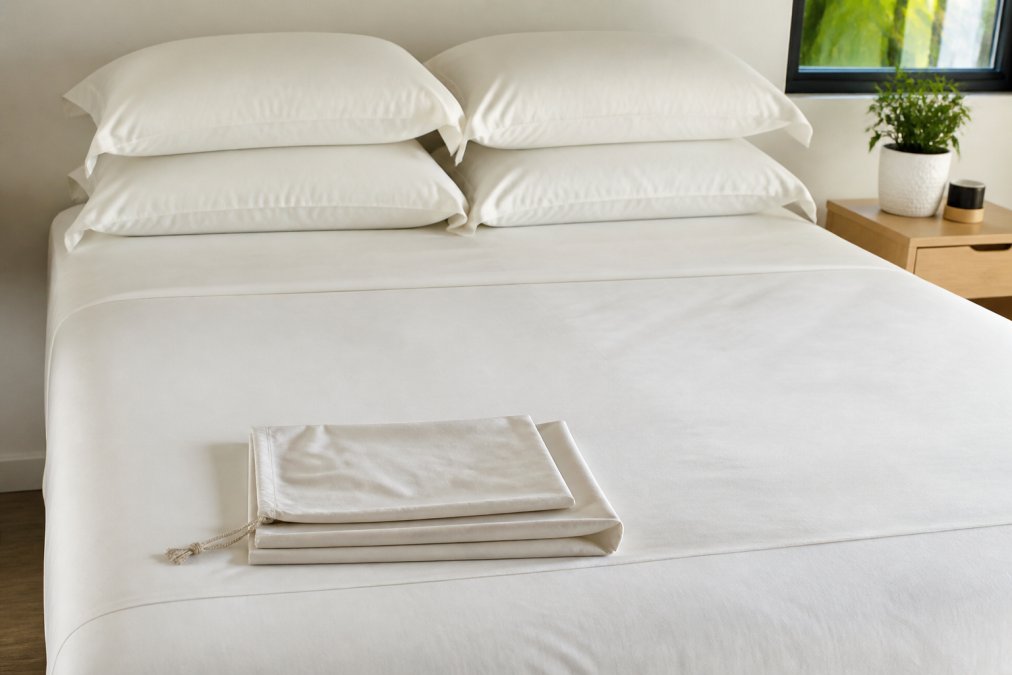
Bamboo bedding sheets promise the cool, silky feel of high-end hotel linens, yet the price gap between sets can feel arbitrary. At Bambusasheets, every set is built around the same idea: a sheet should feel cool on contact, stay put, and be easy to identify when you're half-asleep. Our 7-piece sets run from $83 for a Full to $144 for a King, each with a fitted sheet, flat sheet, four pillowcases, and a storage bag.
| Set | Size | Price | What You Get |
|---|---|---|---|
| Warm Ivory | Full | $83 | 7 pieces, embroidered F corners |
| Fresh White | Full | $83 | 7 pieces, deep pockets |
| Cozy Grey | Full | $88 | 7 pieces, size-marked corners |
| Navy Blue | Full | $88 | 7 pieces, moisture-wicking |
| Classic White | Queen | $129 | 7 pieces, Q corner marks |
| Silky Ivory | Queen | $129 | 7 pieces, hidden size marks |
| Modern Grey | Queen | $135 | 7 pieces, pilling-resistant |
| Navy Cooling | Queen | $135 | 7 pieces, deep pockets |
| Crisp White | King | $144 | 7 pieces, K direction marks |
| Hotel-Luxury Ivory | King | $144 | 7 pieces, extra-deep pockets |
Best Bamboo Sheets for Hot Sleepers: Temperature and Moisture
The best bamboo sheets for hot sleepers are made from bamboo viscose with a breathable weave, because the fiber moves moisture away from skin instead of trapping it.

How bamboo viscose actually moves heat and moisture
Bamboo viscose fiber has a smooth, rounded cross-section with microscopic gaps that form capillary channels. When you sweat, moisture is drawn into the channel and pulled toward drier areas of the fabric, where it evaporates. Cotton works the same way in principle, but it swells when wet, closing the gaps and slowing transfer.
What "thermal-regulating" actually means
Thermal regulation is not the same as cooling. A sheet that only cools will leave you cold once your body temperature drops overnight. Bamboo viscose is a poor heat conductor but a good moisture conductor, so it buffers rather than blasts:
- When you are warm: moisture leaves the skin, evaporative cooling kicks in, and the fabric does not trap a humid layer against you.
- When the room is cold: the fiber's low conductivity means it does not pull heat away from you the way a damp cotton sheet does.
- Through the night: behavior stays consistent instead of degrading as it absorbs moisture.
Matching the property to the problem
Different sleepers need different things from the same fabric:
- Night sweats: prioritize moisture transport, not surface coolness. Look for a sateen weave with a higher thread count per inch, which gives more capillary channels per square inch.
- Menopause-related hot flashes: prioritize buffering. You want a fabric that does not feel cold and clammy when the flash passes.
- Eczema and reactive skin: prioritize dryness plus low friction. A damp sheet against reactive skin is the trigger, not the heat itself. Bamboo's smooth fiber surface reduces the mechanical irritation that comes with tossing on a rougher weave.
- Just runs hot: prioritize breathability.
What to check before you buy
- Fiber length. Long-staple bamboo viscose produces a smoother yarn with fewer protruding fiber ends. Short fibers create a fuzzy surface that traps air and moisture.
- Weave density. A sateen weave uses more yarn per inch than a percale, giving more wicking channels but less airflow. The right choice depends on whether you sweat or just feel warm.
- Finish. Any fabric softener, silicone finish, or anti-wrinkle coating blocks the capillary channels. A sheet that feels slick out of the package and stays slick after washing is probably coated, not naturally smooth.
For anyone who wakes up damp, the Navy Cooling and Hotel-Luxury sets use the long-fiber, sateen-weave combination that keeps the wicking path open.
Softness, Sateen Weave, and Sensitive Skin
The Silky Ivory Queen set is made from long bamboo fibers in a sateen weave, which is what gives it that lustrous, silky glide.
Durability, Pilling, and Deep-Pocket Fit
Pilling is the top complaint about cheap bamboo sheets, and it almost always traces back to short fibers working loose from the yarn and balling up on the surface. Long-fiber construction resists that, which is why our sets use stretchy long bamboo fibers and a no-pilling sateen weave.
- Long fibers: resist pilling wash after wash
- Deep pockets: stay anchored on thick mattresses
- Sateen weave: holds its soft sheen over time
- Corner marks: end the sideways-fitted-sheet problem
How to Wash Bamboo Sheets Without Losing Softness
To wash bamboo sheets without losing softness, use cold water on a gentle cycle and tumble dry on low heat. High heat breaks down the fiber and dulls the finish.
Here's the routine that keeps a set feeling new:
- Wash in cold water on a gentle cycle
- Use a mild detergent, no bleach
- Skip fabric softener entirely
- Tumble dry on low, or hang to dry
- Remove promptly to avoid deep creases
Bamboo Viscose vs Lyocell Sheets: Processing and Feel
Bamboo viscose vs lyocell sheets comes down to how the fiber is made. Both start with bamboo, but they are processed differently, and that shows up in feel, durability, and environmental footprint. "Sustainable" is a claim about a manufacturing method, not a property of the plant.
The two processing routes, step by step
Bamboo viscose breaks bamboo cellulose down with a chemical solvent, typically sodium hydroxide and carbon disulfide, then regenerates the dissolved cellulose into fiber through a spinneret. The result is soft, drapey, and smooth. The trade-off: the solvent is not fully recovered in a conventional viscose line, so a portion leaves as waste that must be treated.
Warm Ivory Bamboo Sheets - Full - Soft →
How the choice shows up over time
The processing difference stops being abstract after six to twelve months of weekly washing:
- Viscose: stays soft, but the surface can develop a slight fuzz as short fibers work loose. Long-staple viscose resists this; short-staple viscose does not.
- Lyocell: holds its surface smoothness longer and resists pilling better, but can feel slightly less plush from the start.
- Bamboo linen: softens noticeably over the first several washes, then stabilizes. It wrinkles more and never develops a sheen.
The environmental question, stated honestly
The sustainability claim for bamboo is real but narrower than most marketing suggests. The plant grows fast, needs little water, and regenerates from the root without replanting. Processing is where the picture gets complicated:
- Viscose: the solvent recovery rate varies widely by manufacturer. A modern closed-loop viscose line recovers most of the solvent; an older line recovers very little. The fiber is the same on the label either way.
- Lyocell: the closed-loop process recovers the solvent at a high rate by design, which is why it carries a lower-impact reputation. It is not zero-impact, but the gap is meaningful.
- Bamboo linen: mechanical processing uses no dissolution solvent, but it is more labor-intensive and produces a different fabric.
Certifications worth checking
Two certifications do most of the useful work:
- OEKO-TEX Standard 100 tests the finished fabric for harmful substances (OEKO-TEX® STANDARD 100). It says nothing about how the fiber was made, but it does confirm the sheet is safe against skin.
- OEKO-TEX Made in Green goes further and covers both chemical safety and manufacturing conditions, including the processing stage.
A sheet can be OEKO-TEX certified and still be made from conventionally processed viscose. The certification is about what is in the fabric, not how the fiber was produced. Read the two claims separately.
Which Bamboo Bedding Sheets Set Fits Your Bed
Matching a set to your bed is simpler than it looks: start with size, pick a color, then confirm the details you care about. Every Bambusasheets set ships with a fitted sheet, flat sheet, four pillowcases, and a storage bag.
Here's how to choose:
- Full mattress: the Warm Ivory or Fresh White set at $83, or step up to Cozy Grey or Navy Blue at $88
- Queen mattress: Classic White or Silky Ivory at $129, or Modern Grey and Navy Cooling at $135
- King mattress: Crisp White or Hotel-Luxury Ivory, both at $144 with extra-deep pockets
- Gift shoppers: the Hotel-Luxury Ivory King set and its storage bag make a ready-to-give package
- Sensitive skin: any set works, since all use hypoallergenic bamboo viscose
Frequently Asked Questions
What is the downside to bamboo sheets?
Bamboo viscose needs gentler care than cotton. Hot water, high dryer heat, and bleach break down the fibers and speed up pilling, so cold water and low heat are the safe settings. Bamboo also wrinkles less than cotton but can feel slippery on a mattress if the fitted sheet is not tucked properly, which is why deep pockets matter.

Can you put 100% bamboo sheets in the dryer?
Yes, on low heat. The care instructions for these sets call for a cold gentle wash and a tumble dry on low. High heat is the main risk because it can shrink the fabric and dull the sateen sheen over time. Skip bleach entirely and pull the sheets out promptly to limit wrinkles.
How do bamboo sheets compare to cotton for temperature regulation?
Bamboo viscose is naturally breathable and moisture-wicking, so it moves sweat away from your skin. That is why hot sleepers often switch.
Do bamboo sheets pill after washing?
Pilling depends on fiber length and wash habits. Long bamboo fibers and a tight sateen weave resist pilling. Washing in cold water on gentle, drying low, and avoiding fabric softener keeps the surface smooth. Our grey and navy options are designed to resist pilling.
Are bamboo bed sheets worth it?
For hot sleepers, sensitive skin, and anyone who wants a silky feel without a high price, yes. A 7-piece set at $83 to $144 includes a fitted sheet, flat sheet, four pillowcases, and a storage bag, so you replace an entire bedding setup in one purchase rather than buying pieces separately.