

Table of Contents
- Bamboo Sheets vs Cotton Durability: The Quick Comparison Table
- How Fiber Structure and Weave Type Decide Longevity
- Pilling, Fading, and Abrasion: Comparing Bamboo Sheets vs Cotton
- Long-Term Wash-Cycle Testing: What Actually Happens Over Time
- Skin Sensitivity and Chemical Processing in Bamboo Viscose
- Benefits of Bamboo Viscose Bedding Beyond Durability
- Bamboo Viscose Bedding Care Instructions for Maximum Lifespan
- Pricing and Value: What You Get for the Money
- Frequently Asked Questions
Last Updated: September 17, 2026
Bamboo Sheets vs Cotton Durability: The Quick Comparison Table
A bamboo sheets vs cotton durability comparison comes down to fiber structure: bamboo viscose is a regenerated cellulose fiber with a smooth, long staple length, while cotton is a natural staple fiber whose length varies by cultivar. That single difference explains most of what follows. This guide from Bambusasheets breaks down how each fiber ages, pills, fades, and holds up across years of washing, so you can judge value instead of marketing claims.
| Factor | Bamboo Viscose | Cotton |
|---|---|---|
| Fiber type | Regenerated cellulose, long staple | Natural staple, length varies |
| Hand-feel | Silky, fluid drape | Crisp to soft, depends on weave |
| Pilling tendency | Lower with long fibers | Higher on short-staple cotton |
| Moisture-wicking | Strong | Moderate |
| Breathability | High | Moderate to high |
| Shrinkage risk | Low with cold washing | Moderate, especially non-preshrunk |
| Typical lifespan | Several years with care | Several years with care |
The honest answer: both can last years. The variable is not the fiber name on the label, it is staple length, weave density, and how you wash them.
How Fiber Structure and Weave Type Decide Longevity
Longevity starts at the fiber level. Bamboo viscose is extruded into long, continuous filaments, which means fewer fiber ends poke through the fabric surface over time. Cotton is spun from shorter staples, and shorter staples mean more exposed ends, which is where pilling and abrasion begin.
But fiber alone does not determine how long a sheet lasts. Weave structure often matters more than the fiber name on the label, and this is where most comparisons stop short.
Percale vs. Sateen: Which Weave Holds Up Longer
Percale uses a one-over-one-under weave. Every warp yarn passes over one weft yarn, then under the next. This creates a tight, balanced, grid-like structure with short yarn floats, the segments of yarn that sit on the fabric surface between interlacements. Short floats mean less exposed yarn to snag, abrade, or pill. Percale is crisp, breathable, and resists pilling well because the yarns are tightly interlocked.
Sateen uses a three-over-one-under weave. The warp yarns float over three weft yarns before interlacing.
Thread Count: The Number That Misleads
Thread count matters less than most shoppers think. A densely woven fabric with a reasonable thread count outperforms a loosely woven one with a padded number. Weave density controls how much friction the yarns absorb during washing and nightly movement. A "1,000 thread count" sheet made from short-staple cotton will pill faster than a well-woven 300-count long-staple sheet. Staple length and weave density are the durability signals; thread count is a marketing number.
How the Two Factors Interact
The durability equation is fiber length multiplied by weave density, not either one alone. A long-staple fiber in a loose weave still abrades because the yarns move and rub against each other. A short-staple fiber in a tight weave still pills because the fiber ends work free regardless of how tightly they are packed. The best-performing sheets combine long fibers with tight, balanced weaves, which is why percale in a long-staple cotton or a well-constructed bamboo viscose sateen both outperform their cheaper counterparts.
Pilling, Fading, and Abrasion: Comparing Bamboo Sheets vs Cotton
Pilling is the most visible durability failure, and it is almost entirely a fiber-length story. Short-staple cotton sheds loose fibers that tangle into pills within the first several washes. Long-fiber bamboo viscose sheds far less, so the surface stays smooth longer.
- Pilling: bamboo viscose lower, short-staple cotton higher
- Fading: similar for both, driven by wash temperature
- Abrasion: bamboo viscose generally better
- Shrinkage: cotton higher unless preshrunk
Long-Term Wash-Cycle Testing: What Actually Happens Over Time
Wash-cycle testing is where marketing claims meet reality. Textile labs typically measure durability through repeated laundering, tracking pilling, tensile strength loss, and shrinkage after each cycle. The pattern is consistent: fabrics that start with long fibers and tight weaves degrade more slowly.
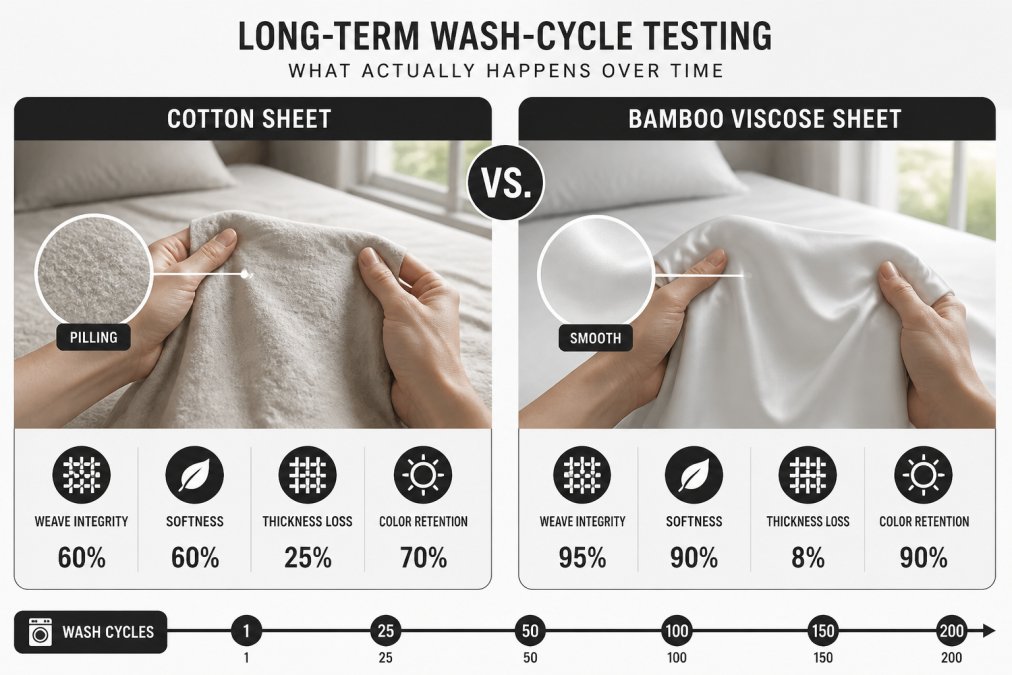
- Baseline: Photograph the sheet flat under consistent lighting before the first wash. Note any existing pills or loose fibers.
- Cycles 1-5: Wash cold on gentle, tumble dry low. Inspect after each cycle under raking light (hold the sheet at an angle to a window).
- Cycles 6-10: Continue the same routine. Measure the fitted sheet's corner-to-corner stretch against your baseline photo.
- Cycles 11-20: Watch for thinning at the foot of the bed and along the pillowcase seam, these are the highest-friction zones.
- Document: A simple photo log at cycles 1, 5, 10, and 20 gives you a visual durability record no marketing claim can match.
What to look for at each checkpoint:
- Pilling: New pills after cycle 5 suggest short staple length. Pills that stop forming after cycle 10 suggest the loose-fiber layer has shed and the fabric is stabilizing.
- Tensile loss: If the sheet feels noticeably thinner or you can see light through it when held to a window, the yarns are abrading faster than expected.
- Shrinkage: Measure the flat sheet's width before and after. Most shrinkage happens in the first three washes; if it continues past cycle 5, the fabric was not properly preshrunk.
- Color: Fading is cumulative and driven by wash temperature and detergent chemistry more than fiber type. Cold water and mild detergent slow it on both bamboo viscose and cotton.
Skin Sensitivity and Chemical Processing in Bamboo Viscose
Skin sensitivity is the angle competitors skip. Bamboo viscose is generally considered hypoallergenic because the smooth filament surface creates less friction against skin, and the fiber naturally resists bacteria and dust mites better than rougher weaves.
OEKO-TEX textile certification standards
Benefits of Bamboo Viscose Bedding Beyond Durability
Durability is only part of the case for bamboo viscose bedding. The same fiber properties that slow wear also deliver comfort advantages that cotton struggles to match.
- Thermoregulation: bamboo viscose adapts to body temperature, which helps hot sleepers stay comfortable
- Moisture-wicking: it moves sweat away from skin faster than standard cotton
- Breathability: the weave allows steady airflow through the night
- Softness: the silky hand-feel holds up over time rather than stiffening
- Eco-friendly profile: bamboo grows quickly and needs less water than conventional cotton
Bamboo Viscose Bedding Care Instructions for Maximum Lifespan
- Wash in cold water on a gentle cycle
- Use a mild, bleach-free detergent
- Tumble dry on low heat, or air dry
- Avoid fabric softener, which coats fibers and reduces breathability
- Rotate two sets so each one rests between washes
- Wash separately from rough items like towels and jeans
Bambusasheets sheets include embroidered size indicators on the bottom corners, which cuts the time you spend matching fitted sheets to the right side of the bed. Small detail, real time saved on laundry day.
Pricing and Value: What You Get for the Money
Price and value are not the same thing. A cheaper cotton set that pills in a year costs more per year of use than a well-made bamboo viscose set that lasts several.
Federal Trade Commission guidance on textile labeling
Frequently Asked Questions
Do bamboo sheets last longer than cotton sheets?
It depends on the cotton type and how you care for both. Long-staple cotton like Egyptian or Pima can last many years with proper washing. Bamboo viscose sheets made from long fibers also hold up well, but they need cold water and low heat to maintain fiber integrity. High-quality bamboo sheets are designed to be strong, breathable, and long-lasting while keeping their softness. The deciding factor is usually wash routine, not the fiber alone.
Are bamboo sheets more prone to pilling than high-quality cotton?
Lower-grade bamboo viscose with short fibers can pill faster than long-staple cotton. The key is staple length: longer fibers resist pilling because fewer loose ends work their way to the surface. Bambusasheets uses long-fiber bamboo viscose in a sateen weave, which reduces friction between the fabric and your skin. Washing in cold water on a gentle cycle and avoiding high heat also cuts down on pilling significantly.
What are the common signs of wear in bamboo viscose bedding?
Watch for increased pilling around the fitted sheet corners, fading in darker or ivory tones, and a loss of that initial silky hand-feel. Shrinkage after hot washes and thinning at high-friction zones like the foot of the bed are also early indicators. Catching these signs early lets you adjust your wash routine before the damage accelerates. Rotating two sets extends the lifespan of both.
How does thread count affect the durability of cotton versus bamboo sheets?
Thread count matters for cotton, but it is not the whole story. A 300-thread-count sateen weave made from long-staple cotton can outlast a 600-thread-count sheet made from short fibers. Bamboo viscose is measured differently because the fibers are finer, so thread count is less useful as a durability marker. For bamboo, look at fiber length, weave density, and care instructions instead of chasing a higher number.
What is the best way to wash bamboo sheets to ensure maximum durability?
Wash in cold water on a gentle cycle and tumble dry on low heat. Avoid bleach and fabric softeners, which break down cellulose fibers over time. Wash bamboo sheets separately from heavy items like jeans or towels to reduce abrasion. If you have a front-loading machine, use the delicate setting. Following these bamboo viscose bedding care instructions keeps the fabric soft and extends its useful life by years.
Durability is not a label claim, it is the result of fiber length, weave density, and how you care for the fabric over years of washing. Bambusasheets builds its 7-piece bamboo viscose sets around long fibers, a delicate sateen weave, and hypoallergenic, temperature-regulating properties that hold their softness. If you want bedding that stays cool, smooth, and intact season after season, get started with Bambusasheets and upgrade the way you sleep.