

Table of Contents
- What Hypoallergenic Sheets Actually Do (and Don't Do)
- Why Your Sheets Might Be Causing a Rash
- Best Hypoallergenic Sheets for Sensitive Skin
- How to Wash Sheets to Prevent Skin Rashes
- Do Hypoallergenic Sheets Stop Skin Rashes for Everyone?
- Frequently Asked Questions
Last Updated: September 13, 2026
What Hypoallergenic Sheets Actually Do (and Don't Do)
Do hypoallergenic sheets stop skin rashes? They can reduce one major trigger, but they are not a cure-all. Hypoallergenic sheets are bedding made from materials and finishes chosen to minimize common allergens and irritants, and they work best when the rash is driven by contact with dust mites, chemical residues, or rough fibers. This guide from Bambusasheets breaks down what these sheets can realistically fix, what they cannot, and how to tell the difference before you spend money on the wrong set.
Here is the uncomfortable truth most product pages skip: a rash that appears after you get into bed usually has more than one cause, and sheets only address some of them.
The Difference Between Allergen Barriers and Irritant-Free Fabric
Allergen barrier describes fabric woven tightly enough to keep dust mites and their waste from passing through to your skin. Irritant-free fabric describes material that does not itself provoke a reaction through roughness or chemical residue.
These are two different jobs, and a single sheet set rarely does both perfectly. A tightly woven barrier fabric can still carry a finishing chemical that irritates sensitive skin. A soft, natural fiber can feel wonderful while letting mite allergens settle right into it.
The Asthma and Allergy Foundation of America's bedding guidance notes that allergen-proof covers work by blocking mite particles, which is a mechanical job, not a chemical one. That distinction matters when you are shopping.
Why Your Sheets Might Be Causing a Rash
Fabric choice is only part of the equation. Three mechanisms drive most sheet-related rashes: chemical residue left from manufacturing, heat and sweat trapped against the skin, and friction from rough or pilling fibers.
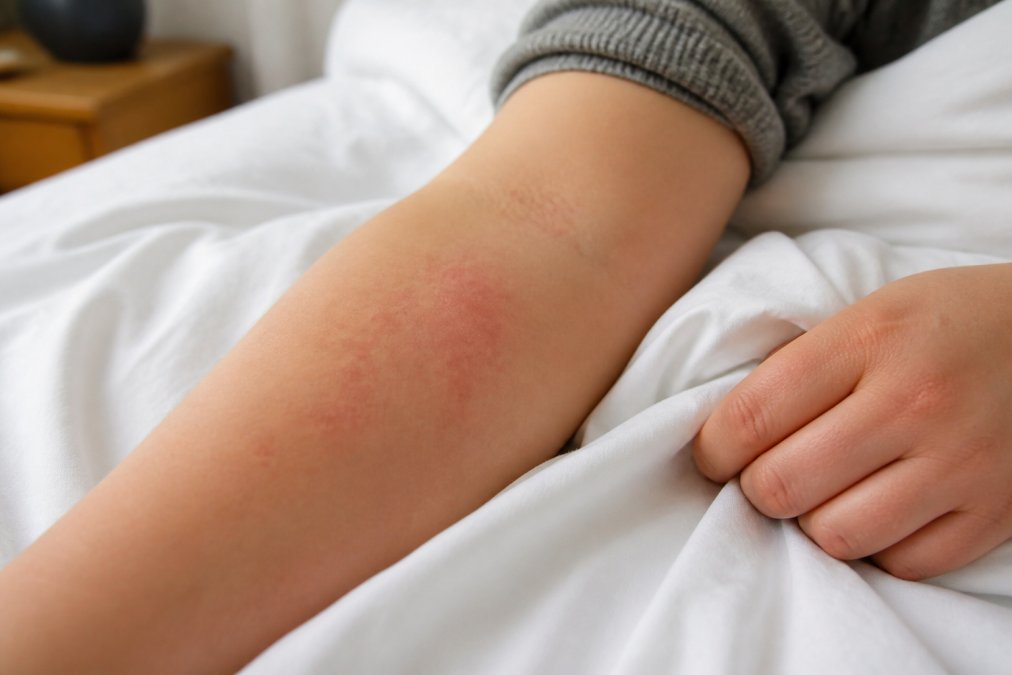
A common mistake is blaming the fiber type when the real culprit is the finish applied to it. The U.S. Consumer Product Safety Commission oversees textile flammability and finishing requirements, and some treatments used to make fabric wrinkle-resistant or flame-retardant can trigger reactions in people with chemical sensitivity.
Chemical Residue and Textile Finishes
Formaldehyde-based resins, dyes, and optical brighteners are the finishes most often linked to contact dermatitis from bedding. These are not always listed on a label, which is why certification matters more than marketing language.
Look for OEKO-TEX certified bedding. That certification tests for harmful substances rather than simply asserting a product is gentle. If a set claims "hypoallergenic" with no certification behind it, treat the claim as a marketing term, not a guarantee.
Heat, Sweat, and Friction
Thermal regulation and skin health are linked more tightly than most shoppers realize. When you overheat at night, sweat sits against your skin, softens the skin barrier, and makes it easier for friction and residue to cause irritation.
Synthetic materials like polyester trap heat and moisture. Natural fibers such as organic cotton, bamboo viscose, and silk bedding move moisture away from the body instead. For anyone dealing with night sweats, that difference between a breathable fiber and a heat-trapping one often decides whether a rash clears up.

Best Hypoallergenic Sheets for Sensitive Skin
The best hypoallergenic sheets for sensitive skin balance three traits: breathable fibers, minimal chemical finishing, and a smooth surface that reduces micro-abrasion. No single fabric wins on all three, so the right pick depends on your specific trigger.
| Fabric | Breathability | Irritation Risk | Best For |
|---|---|---|---|
| Bamboo viscose | High | Low | Hot sleepers, sensitive skin |
| Organic cotton | Medium-high | Low | Everyday use, easy care |
| Silk | Medium | Very low | Friction-sensitive skin |
| Linen | High | Medium (texture) | Cool sleepers |
| Polyester blends | Low | Higher | Budget only |
Why Fiber Type Alone Does Not Predict Irritation
Two 100% cotton sheets can behave completely differently against reactive skin. The variable is not the fiber, it is what was done to the fiber after weaving. A conventional cotton sheet finished with a formaldehyde-based wrinkle-resistant resin can provoke contact dermatitis in a sensitive sleeper, while an unfinished organic cotton sheet of the same thread count stays inert.
This is why the fiber table above is a starting point, not a verdict. Read it alongside the finishing question below.
The Finishing Question Most Guides Skip
Manufacturers apply chemical finishes to bedding for practical reasons: to reduce wrinkling, hold color, resist shrinkage, and meet flammability standards. The finishes most often linked to skin reactions are:
- Formaldehyde-based resins used for durable-press and wrinkle-free properties
- Azo dyes and disperse dyes, which can trigger contact dermatitis in dye-sensitive individuals
- Optical brighteners, added to make whites look brighter than the fiber naturally is
- Flame retardants, required in some textile categories and persistent on fabric
These are not always disclosed on a care label. That is the gap between a sheet marketed as "hypoallergenic" and a sheet that has actually been tested for harmful substances.
Certifications That Do the Testing for You
Two certifications carry real weight when you are shopping for reactive skin:
- OEKO-TEX Standard 100 tests finished textiles for harmful substances, including formaldehyde, heavy metals, and certain dyes. It is the most relevant certification for skin-contact bedding.
- GOTS (Global Organic Textile Standard) covers both the organic fiber content and restricted chemical inputs through processing, so it addresses the finish question as well as the fiber question.
If a set claims "hypoallergenic" with no certification behind it, treat the claim as a marketing term, not a guarantee. A certification number you can look up is worth more than a label adjective.
Matching Fabric to Your Actual Trigger
Use the table above together with your symptom pattern:
- Friction or texture sensitivity (rash along pressure points, worse on rougher sheets): silk or bamboo viscose sateen, both of which present a smooth, low-shear surface.
- Heat and sweat-driven irritation (rash in skin folds, worse in summer): bamboo viscose or linen, which move moisture and allow airflow.
- Dust mite allergy (congestion plus rash, worse in humid months): no sheet fiber alone solves this. Pair any breathable sheet with an allergen-proof mattress and pillow encasement underneath.
- Chemical sensitivity (reaction to new sheets that fades after several washes): prioritize OEKO-TEX or GOTS certified bedding and wash before first use.
Bamboo viscose earns its place at the top for most sensitive sleepers because it combines a silky, low-friction surface with strong moisture-wicking. Bambusasheets builds its 7-piece sets from long-fiber bamboo viscose in a delicate sateen weave, which keeps the surface smooth and the fabric breathable without a heavy finish. The sets also include embroidered size indicators, so you are not wrestling with a fitted sheet at midnight, and a storage bag for keeping spare linens clean between washes.
Here is the honest limitation: bamboo viscose is not a barrier fabric in the dust-mite sense. If mites are your trigger, pair it with an allergen-proof mattress encasement underneath.
How to Wash Sheets to Prevent Skin Rashes
Washing is where most people accidentally undo the benefit of good sheets. Laundry residue from too much detergent, fabric softener, or scent boosters is one of the most overlooked causes of bedtime irritation, and it is frequently misattributed to the sheets themselves.
The Detergent Misattribution Problem
A common pattern dermatologists describe: a sleeper switches to hypoallergenic sheets, keeps their usual scented detergent, and sees no improvement. They conclude hypoallergenic bedding does not work. In reality, the sheets were never the trigger, the residue left on them was.
Detergent residue stays in the weave and presses against your skin for eight hours a night. That is a long exposure window for a mild irritant to become a real problem. If you change only one variable at a time, you can actually identify the cause:
- Wash the new sheets with your existing detergent for two weeks and note symptoms.
- Switch to a fragrance-free, dye-free detergent and wash the same sheets for two weeks.
- Compare. If symptoms improve on step two, the detergent was the trigger, not the fiber.
This is the diagnostic step most guides skip, and it is the one that saves you from buying a third set of sheets you did not need.
A Wash Routine Built for Reactive Skin
- Wash in warm water, not hot, to protect fibers while still removing oils
- Use a fragrance-free, dye-free detergent and roughly half the recommended amount
- Skip fabric softener entirely; it coats fibers and traps residue
- Add an extra rinse cycle if anyone in the home has reactive skin
- Dry on low or line dry to prevent fiber damage and pilling
- Wash weekly, or twice weekly during allergy season
Why Each Step Matters
Half the recommended detergent. Detergent makers dose for the heaviest soil load, not for lightly soiled sheets. More suds do not mean cleaner sheets, they mean more residue left against your skin. If your washer is high-efficiency, the correct dose is often a fraction of the cap.
No fabric softener. Softeners work by depositing a waxy film on fibers. That film is what makes towels feel plush, and it is also what traps detergent residue and reduces a fabric's ability to wick moisture. For reactive skin, softener is counterproductive.
No scent boosters or dryer sheets. Fragrance is the most common cosmetic allergen in laundry products. Scent beads and dryer sheets add a fragrance load that persists on fabric for multiple washes.
Extra rinse. A second rinse cycle is the single cheapest intervention for suspected detergent sensitivity. It costs nothing but water and time, and it removes the residue that a single rinse leaves behind.
Warm, not hot. Hot water can set protein-based stains and accelerate fiber breakdown, which produces the pilling and roughness that cause friction irritation. Warm water with a proper detergent handles normal soil.
Detergent Choice and Laundry Residue
The American Academy of Dermatology's guidance on eczema recommends fragrance-free and dye-free products for people with eczema-prone skin, and bedding is one of the highest-exposure textiles in the home. If you switch to hypoallergenic sheets but keep a scented detergent, you may see no improvement at all.
Look for detergents labeled "free and clear" or "free of dyes and perfumes." These formulations still clean effectively, they simply omit the additives most likely to irritate skin.
Do Hypoallergenic Sheets Stop Skin Rashes for Everyone?
No. Hypoallergenic sheets stop skin rashes only when the trigger is contact-based, meaning dust mites, chemical residue, heat, or friction. If your rash comes from a food allergy, a medication reaction, or a skin condition like eczema with no environmental trigger, changing sheets will not resolve it.
A dermatologist can help you identify which category you fall into. If the rash appears within hours of getting into bed, clears when you sleep elsewhere, and worsens in warm months, contact triggers are likely. If it persists regardless of bedding, the cause sits elsewhere.
What most guides miss is that bedding hygiene is cumulative. Sheets, pillowcases, mattress protectors, and duvet covers all contribute. Replacing only the fitted sheet while leaving a dusty duvet in place rarely solves the problem.
For sleepers who run hot, the temperature angle deserves equal weight. Choosing moisture-wicking, breathable fibers reduces sweat-induced irritation, which is a distinct problem from allergy. Bambusasheets designs its bamboo viscose sets specifically around cooling comfort and a kind-to-skin surface, which addresses the heat and friction side of the equation directly.
If you have cycled through "hypoallergenic" labels without relief, the missing piece is usually the combination of chemical finish, trapped heat, and friction, not the fiber name alone. Bambusasheets approaches that combination with long-fiber bamboo viscose, a smooth sateen weave, naturally breathable construction, and a set that stays put and stays clean. If your rash tracks with time spent in bed, start with bedding built for sensitive, hot sleepers rather than another generic cotton set. Explore the Bambusasheets 7-piece bamboo viscose collection and give your skin a surface that works with it, not against it.
Frequently Asked Questions
Why are my sheets giving me a rash?
Sheets can trigger rashes through several pathways: chemical residue from textile finishes, friction from rough or pilling fibers, trapped heat and sweat, or allergens like dust mites that accumulate in bedding. Synthetic materials and heavy detergent residue are common culprits. If your rash appears after switching sheets or detergent, those are the first variables to change. Switching to hypoallergenic sheets made from breathable natural fibers and washing them thoroughly before first use can resolve many cases.
What is the best material for bed sheets that are hypoallergenic?
Bamboo viscose, organic cotton, and silk bedding are among the best hypoallergenic sheets for sensitive skin. These natural fibers are breathable, smooth, and less likely to trap dust mites or cause micro-abrasion. Bamboo viscose in particular offers moisture-wicking properties and a silky texture that reduces friction. Look for OEKO-TEX certified fabrics to confirm they are free from harmful chemical finishes. Avoid synthetic materials like polyester, which trap heat and can worsen irritation.
Can laundry detergent cause skin rashes from sheets?
Yes. Laundry detergent residue left in fabric is a frequent cause of contact dermatitis. Fragrances, dyes, and harsh surfactants in conventional detergents can irritate sensitive skin, especially when sheets are not rinsed thoroughly. Use a fragrance-free, dye-free detergent and consider an extra rinse cycle. If you have chemical sensitivity, wash new sheets before first use to remove any manufacturing residue. This step alone resolves many persistent rash complaints.
How often should you wash sheets to prevent skin irritation?
Wash sheets at least once a week to prevent buildup of sweat, oils, dead skin cells, and dust mites. If you have allergies or night sweats, wash every three to four days. Dry completely before making the bed to prevent mold and mildew. Regular bedding maintenance preserves the hypoallergenic properties of your sheets and keeps your sleep environment clean. Bamboo viscose and organic cotton hold up well to frequent washing when cared for properly.