

Table of Contents
- Why Folding a Fitted Sheet Feels Impossible (And How to Fix It)
- What You'll Need Before You Start
- How to Fold a Fitted Sheet Neatly: Step-by-Step
- How to Fold a Fitted Sheet Quickly: The Under-One-Minute Method
- How to Fold a Fitted Sheet With Deep Pockets
- How to Keep Sheet Sets Together in Storage
- Troubleshooting Common Folding Problems
- Frequently Asked Questions
Last Updated: October 8, 2026
Why Folding a Fitted Sheet Feels Impossible (And How to Fix It)
Learning how to fold fitted sheets easily starts with one truth: the sheet is not the problem. The elastic corners are. Most people grab a fitted sheet, try to fold it flat like a pillowcase, and end up with a lumpy ball.
Here at Bambusasheets, we hear this complaint constantly from customers who own our 7-piece bamboo viscose sets. The good news? Once you understand the corner tuck, the whole thing takes seconds.

That single move is the difference between a messy linen closet and one that looks like a store display.
The Real Problem: Elastic Corners and Stretchy Fabric
A fitted sheet has four elastic edges that pull against any flat fold you attempt. That is the whole issue.
Stretchy fabric makes it worse. Every time you smooth one corner, another springs back. Deep-pocket sheets add more fabric to manage.
The fix is not force. It is working with the corners instead of against them.
What You'll Need Before You Start
You need very little to fold a fitted sheet neatly:
- A flat surface, like a bed or a large table
- Clean, dry hands
- The fitted sheet, right side out
- Thirty seconds of patience
That is it. No clips, no boards, no gadgets.
If your sheet has embroidered size indicators on the corners, this step gets easier. Ours are stitched right into the fabric, so you always know which end is which.
How to Fold a Fitted Sheet Neatly: Step-by-Step
Here is the classic method, broken into four simple steps. Follow them in order and you will get a flat rectangle every time.
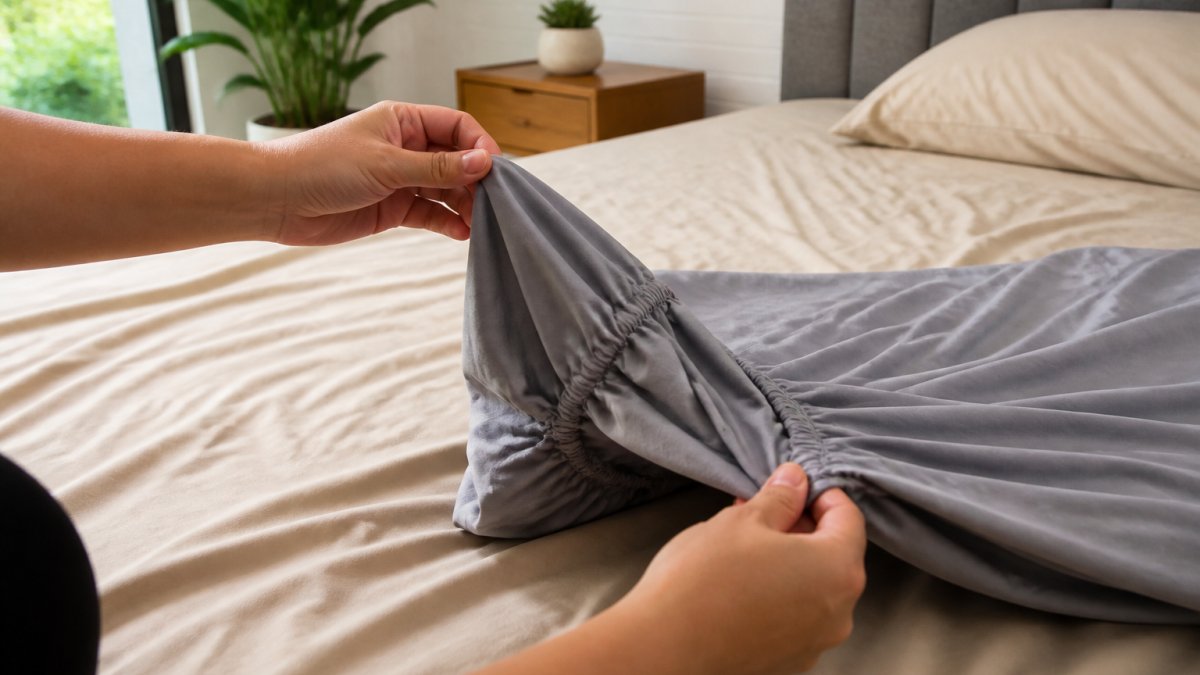
Step 1: Identify the Long Edge and Short Edge
Lay the sheet flat with the elastic side facing up. Find the long edge and the short edge.
Hold the sheet by two corners on one short edge, one in each hand. Let the rest drape down.
Step 2: Tuck One Corner Into Another
Bring your hands together. Tuck one corner into the other, so the corner seams nest inside each other.
Now do the same with the remaining two corners. You should have a folded shape with all four corners stacked.
Lay it on your flat surface. Smooth the fabric with your hands.
Step 3: Align the Elastic Edges
This is the step most people skip, and it is the one that decides whether the finished bundle is flat or lumpy. Run your fingers along the elastic hem and pull it straight so the two elastic edges line up with each other. Press the seam flat with the heel of your hand.
If the elastic bunches in one spot, work it loose with your thumbs before you fold. Bunched elastic is what creates the bulge that makes a folded sheet refuse to stack.
Step 4: Fold the Rectangle Into Thirds
Fold the sheet in half lengthwise, then fold it into thirds. Align the edges as you go.
You now have a compact, stackable rectangle. That is the whole technique.
A Note on Sheet Sizes and Fabrics
The same four steps work across sizes, but the fold count changes:
- Twin and twin XL: Fold into thirds. The smaller footprint rarely needs a quarter fold.
- Full and queen: Fold into thirds, then press flat. Queen sheets are the most common size and fold cleanly at this count.
- King and California king: Fold into quarters. The extra width will not sit flat in thirds.
- Deep-pocket sheets: Always quarter-fold, regardless of size. The extra fabric has to go somewhere.
Fabric matters too. Slippery fabrics like sateen and bamboo viscose slide apart mid-fold, so press each fold with your palm before starting the next one. Crisp cotton holds a crease on its own and needs less pressing. Stretchy knits behave like deep-pocket sheets, quarter-fold them and expect to smooth more.
How to Fold a Fitted Sheet Quickly: The Under-One-Minute Method
Want the fast version? Skip the flat surface entirely.
Cozy Grey Bamboo Sheets - Full - 7pc Size-Marked Corners →
Hold the sheet by two adjacent corners, one in each hand. Tuck one corner into the other, then fold the whole thing in half twice.
You will get a less perfect rectangle, but it takes under a minute. This quick method works well for daily laundry when neatness matters less than speed.
How to Fold a Fitted Sheet With Deep Pockets
Deep-pocket sheets hold more fabric, so they need one extra fold.
Follow the same four steps, but fold the rectangle into quarters instead of thirds. The extra fabric gets tucked inside, and the bundle stays compact.
Adjusting the Fold for Common Sheet Sizes
Deep pockets are not one thing. A deep-pocket twin and a deep-pocket king behave differently, and the fold count should change with them:
| Sheet size | Pocket depth | Fold count | Why |
|---|---|---|---|
| Twin / twin XL | Standard or deep | Thirds | Narrow footprint, little excess fabric |
| Full | Standard or deep | Thirds, then press | Fits most shelves at this count |
| Queen | Standard | Thirds | The most common size; folds cleanly |
| Queen | Deep | Quarters | Extra fabric needs the fourth fold |
| King / California king | Standard | Quarters | Width will not sit flat in thirds |
| King / California king | Deep | Quarters, then press | The bulkiest combination |
If you are not sure which category your sheet falls in, measure the pocket. Anything past roughly 15 inches is generally sold as deep pocket; past 18 inches is often labeled extra-deep. Those numbers are the industry's rough dividing lines, not a hard standard, so treat them as a guide.
Working With Stretchy and Slippery Fabrics
Fabric type changes how the fold behaves more than size does:
- Bamboo viscose and other stretchy fibers: The fabric flexes around the corners instead of fighting them, which helps. But it also springs back, so press each fold with your palm before starting the next one.
- Sateen and high-thread-count cotton: Slippery surfaces slide apart mid-fold. Fold on a textured surface like a bedspread rather than a bare table.
- Linen: Wrinkles set quickly. Fold it straight from a warm iron or while it is still slightly warm from the dryer.
- Knits and jersey: Treat them like deep-pocket sheets, quarter-fold and smooth more often.
Folding Without a Large Flat Surface
If you do not have a bed or table to work on, you can still get a neat fold. Hold the sheet by two adjacent corners and tuck one into the other in the air. Then lay the bundle across your forearm and fold it against your body, using your chest as the flat surface. It is slower and less precise, but it works in a small laundry room or from a laundry basket.
For limited mobility, sit on the edge of the bed and fold the sheet across your lap. The lap gives you a stable surface at a comfortable height, and you never have to reach across a wide bed.
How to Keep Sheet Sets Together in Storage
Folding is half the job. Keeping the set together is the other half.
Try these habits:
- Store the folded fitted sheet inside its matching flat sheet
- Slide both pillowcases into the same bundle
- Use the storage bag that came with your set
- Stack sets by size so you grab the right one fast
Our sets arrive with a storage bag for exactly this reason. The embroidered size marks on the corners mean you never have to unfold a sheet just to check if it fits.
Troubleshooting Common Folding Problems
Some folds just will not cooperate. Here is how to fix the usual problems.
| Problem | Likely Cause | Fix |
|---|---|---|
| Lumpy, uneven bundle | Corners not nested | Tuck each corner fully inside the next |
| Sheet springs open | Elastic stretched during folding | Fold on a flat surface, press as you go |
| Too bulky to stack | Deep pockets not flattened | Fold into quarters, not thirds |
| Cannot tell top from bottom | No size or direction mark | Check corner labels before folding |
| Wrinkles set in | Sheet folded damp | Dry fully, then fold right away |
A common mistake is folding a warm sheet straight from the dryer. Let it cool for a minute. Warm fabric holds whatever shape you give it, including every wrinkle.
If your sheet keeps sliding off the bed during the night, the problem is usually fit, not folding. Deep pockets and stretchy long fibers hold better than shallow ones.
Frequently Asked Questions
Why are fitted sheets so hard to fold?
The elastic edges pull the fabric into a cupped shape, so the sheet never lies flat on its own. Stretchy fabrics like bamboo viscose make it trickier because the corners bounce back after you smooth them. The fix is to nest the corners first, which turns four elastic corners into one manageable bundle, then fold the remaining fabric into a rectangle before folding into thirds.
What is the most efficient way to store fitted sheets?
Fold the entire set together: fitted sheet, flat sheet, and pillowcases stacked as one bundle, then slide it into the matching storage bag or a pillowcase. Bambusasheets sets include a storage bag for exactly this. Storing sets as one unit keeps everything matched and makes grabbing a fresh set from the linen closet a single motion instead of a hunt.
How do I fold a fitted sheet with deep pockets?
Deep-pocket sheets have more fabric at each corner, so start by holding the sheet inside out with the elastic facing you. Tuck one corner into another and repeat on the opposite side, then lay the nested bundle on a flat surface and smooth the fabric toward the center. Fold the excess fabric inward before folding into thirds so the deep pockets do not create bulky lumps.
Can you fold a fitted sheet by yourself?
Yes. The corner-tucking method is a one-person technique. Hold two adjacent corners in one hand, tuck one into the other, then repeat with the remaining two corners. Once all four corners are nested, the sheet behaves like a flat rectangle and you can fold it on any bed or table without a second pair of hands.
Folding a fitted sheet is a small skill, but it pays off every laundry day. If you want sheets that make the job easier, our bamboo viscose sets include embroidered size indicators, deep pockets, and a storage bag to keep everything together. The silky sateen weave stays smooth and cool, and the stretchy long fibers hold their shape wash after wash. Get started with Bambusasheets and turn your linen closet into the tidiest spot in the house.