

Table of Contents
- Why Identifying a Fitted Sheet Size Matters
- How to Measure a Fitted Sheet: Step-by-Step
- Fitted Sheet Size Chart: Match Measurements to Standard Sizes
- Fitted Sheet Pocket Depth: Deep Pocket vs. Standard Fit
- What to Do When a Fitted Sheet Is Too Small
- Accounting for Elastic, Shrinkage, and Fabric Stretch
- Identifying an Unlabeled Sheet Without a Mattress
- Frequently Asked Questions
Last Updated: October 17, 2026
Why Identifying a Fitted Sheet Size Matters
Knowing how to tell fitted sheet size saves you from the most common bedding headache: a sheet that almost fits.
Fitted sheets are cut to match specific mattress dimensions, with elastic corners that grip the edges. A Twin measures 39 x 75 inches (Bed Sheet Sizes).
Below, we'll show you exactly how to measure a fitted sheet, read pocket depth, and match your numbers to a standard size chart.
How to Measure a Fitted Sheet: Step-by-Step
The quickest way to measure a fitted sheet is to stretch it flat and measure corner to corner, then measure the pocket depth. You'll need a retractable measuring tape and a flat surface.
Follow these steps:
- Lay the sheet flat on a clean floor or a large table.
- Smooth out wrinkles and stretch the elastic corners outward.
- Measure from corner seam to corner seam for width.
- Measure the same way for length.
- Measure the pocket depth from the seam to the elastic edge.
- Write down all three numbers before you refold.
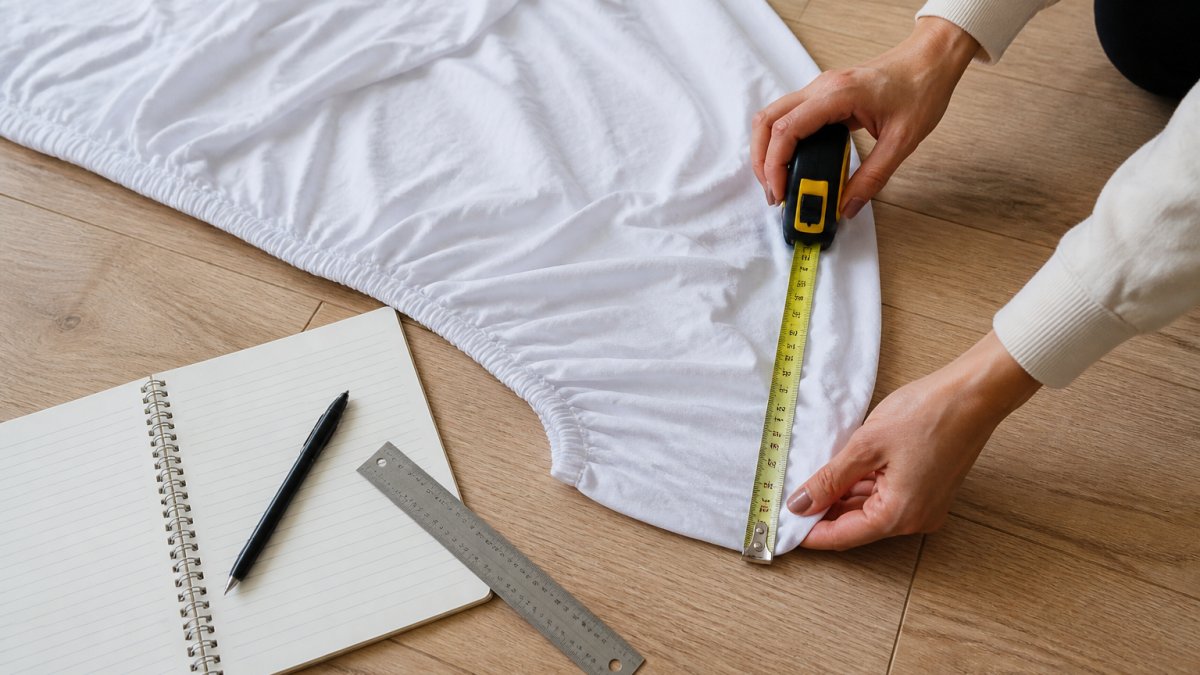
Measuring Width and Length Corner to Corner
Stretch the sheet until the elastic corners sit taut, then measure seam to seam. A fitted sheet's width and length should match your mattress dimensions closely. If your measurement lands near 39 x 75 inches, you likely have a Twin. Near 60 x 80 inches points to a Queen.
How to Measure Fitted Sheet Pocket Depth Accurately
Pocket depth is the distance from the flat top of the sheet down to the bottom edge of the elastic. Hook your tape at the corner seam and pull straight down to the elastic hem. Standard pockets run about 10 to 12 inches deep. Deep pockets run 14 inches or more. Measure at two corners and average them, since elastic can stretch unevenly.
Fitted Sheet Size Chart: Match Measurements to Standard Sizes
Use this fitted sheet size chart to match your measurements to a standard bed size. Compare your width, length, and pocket depth against each row.
| Bed Size | Fitted Sheet Width x Length | Common Pocket Depth |
|---|---|---|
| Twin | 39 x 75 inches | 10-12 inches |
| Twin XL | 39 x 80 inches | 10-12 inches |
| Full | 54 x 75 inches | 10-12 inches |
| Queen | 60 x 80 inches | 10-14 inches |
| King | 76 x 80 inches | 12-14 inches |
| California King | 72 x 84 inches | 12-14 inches |
Measure twice before you buy. Fabric stretch and shrinkage can shift your numbers by an inch or two, so factor that in when you compare.
Twin vs. Twin XL and Full vs. Queen Dimensions
Twin and Twin XL differ by just five inches of length: 39 x 75 inches versus 39 x 80 inches (Twin vs. Twin XL Mattress Comparison 2025). Full and Queen differ by six inches of width: 54 x 75 inches versus 60 x 80 inches. Those small gaps are exactly why a "close enough" sheet slips off. If your measurement sits between two sizes, go with the larger one for a snug fit.
Fitted Sheet Pocket Depth: Deep Pocket vs. Standard Fit
Pocket depth is the single number that decides whether a fitted sheet stays on or pops off at 2 a.m. It is also the number most shoppers never measure. Standard pockets fit mattresses roughly 10 to 12 inches thick. Deep pockets handle mattresses and toppers that run 14 inches or more. Extra-deep pockets, sometimes labeled 18-inch or 21-inch, are built for pillow-top and extra-thick mattresses.
How to Measure Pocket Depth on a Mattress
You are measuring the vertical drop from the top surface of the mattress down to the bottom edge where the sheet tucks under. Here is the reliable method:
- Remove all bedding so you are measuring the bare mattress.
- Hook the end of a retractable tape at the top corner seam of the mattress.
- Pull the tape straight down the side to the bottom edge, where the mattress meets the foundation or frame.
- Read the number at the bottom edge. That is your mattress depth.
- Repeat at all four corners and use the largest reading, since mattresses are rarely perfectly even.
A common pattern is for a mattress to measure a half inch deeper at one corner than another. Sizing to the largest corner prevents a tight fit that strains the elastic.
Add the Topper Before You Match a Sheet
If you use a mattress pad, topper, or feather bed, add its height to the mattress depth before you compare pocket sizes. A two-inch memory-foam topper on a 12-inch mattress gives you a 14-inch stack, which pushes you from standard into deep-pocket territory.
Leave a little slack. A sheet whose pocket depth exactly equals your stack height will fit, but it will be tight and prone to popping.
Standard vs. Deep vs. Extra-Deep at a Glance
| Pocket Type | Typical Depth | Fits a Mattress Stack Of |
|---|---|---|
| Standard | 10-12 inches | 8-12 inches |
| Deep | 14-16 inches | 12-15 inches |
| Extra-deep | 18-21 inches | 15-20 inches |
A deep-pocket sheet on a thin mattress is not harmless: the excess fabric wrinkles, bunches under your back, and wears at the fold lines. A standard sheet on a thick mattress is worse, because the corners pop off and the elastic stretches out permanently. Match the pocket to the stack, not to the mattress label.
Cozy Grey Bamboo Sheets - Full - 7pc Size-Marked Corners →
Fabric matters here too. Stretchy long-fiber weaves grip a deep stack better than stiff, low-stretch weaves, because the elastic and the fabric share the strain instead of the elastic taking all of it. Our bamboo viscose sets, like the Cozy Grey Bamboo Sheets in Full, include deep pockets built for thicker mattresses and toppers.

What to Do When a Fitted Sheet Is Too Small
A fitted sheet that's too small will pop off, wrinkle, and wear out faster at the corners. Don't force it. Instead, try these fixes:
- Add sheet suspenders or corner straps to hold the edges down.
- Use a fitted sheet extender strip to add a few inches of reach.
- Switch to a deep-pocket sheet if your mattress is thick.
If the sheet is only slightly small, washing it cold and stretching it damp over the mattress can help temporarily. But if it keeps slipping, the pocket depth is wrong for your bed. Replace it rather than fight it every night.
Accounting for Elastic, Shrinkage, and Fabric Stretch
Fabric changes over time, and your measurements should account for it. Elastic loses tension after repeated washing. Natural fibers can shrink in a hot dryer. Stretchy weaves relax with use.
Keep these points in mind:
- Measure a sheet after washing and drying it, not straight from the package.
- Expect up to a couple inches of shrink in cotton over its life.
- Elastic weakens with high heat, so wash cold and dry low.
This is where fabric quality shows. Our Modern Grey Bamboo Sheets in Queen use a sateen weave with long fibers that resist pilling and hold their stretch. Cold wash and low tumble dry keep them fitting right for years.

Identifying an Unlabeled Sheet Without a Mattress
This is the situation most guides skip: you are holding a loose sheet with no tag, no packaging, and no mattress nearby. You cannot measure the bed, so you measure the sheet and reason backward. Here is a decision path that gets you to a size in about two minutes.
Step 1: Measure the Sheet Flat
Lay the sheet on a clean floor or a large table and stretch the elastic corners outward until the seams sit taut. Measure seam to seam for width, then seam to seam for length. Do not measure the stretched elastic edge itself, because elastic length varies with age and tension. Write down both numbers plus the pocket depth.
Step 2: Run the Numbers Through the Decision Tree
- Width near 39 inches? It is a Twin or Twin XL. Check length: 75 inches means Twin, 80 inches means Twin XL.
- Width near 54 inches? That is a Full. Confirm with a 75-inch length.
- Width near 60 inches? That is a Queen. Confirm with an 80-inch length.
If your numbers land within an inch or two of a row, that is your size. If they land between two rows, size up, because a slightly large sheet tucks in while a slightly small one pops off.
Step 3: Read the Shape and Elastic Cues
Measurements are not the only signal. A fitted sheet is cut with corner gussets, and the gusset depth tells you the pocket size even when the flat dimensions are ambiguous. Look at the corner seam: a shallow gusset points to a standard pocket, a deep one to a deep pocket. Also check the elastic. A sheet with elastic only at the corners is usually a standard fit; a sheet with elastic running along the entire hem is often a deep-pocket design built to grip a thicker stack.
Step 4: Watch for Nonstandard Sizes
Standard charts do not cover everything. Split king and split queen setups use two smaller fitted sheets rather than one wide one, so a sheet measuring roughly 38 x 80 inches may be half of a split king. RV and camper beds, short queens, and antique or three-quarter beds all fall outside the standard rows. If your numbers sit well off every row, measure again, note the pocket depth, and treat the sheet as a nonstandard size rather than forcing it into the nearest standard label.
This is exactly the problem our embroidered size indicators solve. Each Bambusasheets set, including the Crisp White Bamboo Sheets in King, has a small stitched letter on the bottom corners. You grab the right size and direction in seconds, no tape required.

Frequently Asked Questions
How do you know what size fitted sheet to get?
Measure your mattress width, length, and depth with a tape measure, then match those numbers to a fitted sheet size chart. For example, a mattress measuring 60 x 80 inches with a 12-inch depth needs a Queen fitted sheet with at least 12-inch pockets. Always add 1 to 2 inches to the pocket depth to account for shrinkage and mattress toppers. If your mattress is deeper than 15 inches, look for deep-pocket sheets labeled accordingly.
What is the standard size of a fitted sheet?
Standard fitted sheet sizes follow mattress dimensions: Twin is 39 x 75 inches, Twin XL is 39 x 80 inches, Full is 54 x 75 inches, Queen is 60 x 80 inches, King is 76 x 80 inches, and California King is 72 x 84 inches. Pocket depth typically ranges from 10 to 14 inches for standard sheets, while deep-pocket versions extend to 18 inches or more. Always check the product label, as sizing can vary slightly between brands.
How can you tell whether a fitted sheet is too small?
A fitted sheet is too small if the corners won't reach the bottom of your mattress or the elastic pulls tight before covering all four corners. Lay the sheet flat and measure its width and length; if either is less than your mattress dimensions plus 2 inches, it's too small. Pocket depth also matters: a sheet with 10-inch pockets won't fit a 14-inch mattress. If the sheet pops off repeatedly during the night, it's likely undersized for your bed.
Does mattress depth matter when choosing a fitted sheet?
Yes, mattress depth is critical. Measure from the base to the top of the mattress, including any topper. A standard fitted sheet fits mattresses up to about 14 inches deep, while deep-pocket sheets accommodate 15 to 18 inches or more. If your sheet's pocket depth is less than your mattress depth, the corners will slip off. Always choose a pocket depth at least 1 to 2 inches deeper than your mattress to allow for shrinkage and a snug fit.
Sorting bedding shouldn't feel like a puzzle. If you're ready to skip the measuring tape entirely, Bambusasheets makes it simple with embroidered size indicators, deep pockets that grip thick mattresses, and cooling bamboo viscose that stays soft wash after wash. Explore our 7-piece sets, each with a storage bag to keep everything paired. Get started with Bambusasheets and make your bed in seconds, every time.