

Table of Contents
- Why Fitted Sheets Bunch Up
- Fix 1: Choose the Correct Sheet Size for Your Mattress
- Fix 2: Account for Mattress Toppers and Deep Pockets
- Fix 3: How to Wash Bamboo Sheets Correctly to Preserve Elasticity
- Fix 4: Use Fitted Sheet Suspenders and Corner Clips
- Fix 5: Master the Proper Tucking Technique
- Fix 6: Fold and Store Sheets to Prevent Stretching
- Fix 7: Invest in Quality Sheets with Durable Elastic
- Frequently Asked Questions
Last Updated: September 20, 2026
Why Fitted Sheets Bunch Up
Fitted sheets bunch up because of three core issues: your mattress depth doesn't match your sheet pocket depth, the elastic band degrades over time, and fabric friction plays a bigger role than most people realize. Understanding these root causes is the first step to keeping your sheets smooth and secure all night long.
The good news: it's fixable. Most bunching happens because people buy sheets without checking mattress dimensions, or they don't account for mattress toppers that add extra thickness. The fixes are straightforward and work fast.
Below, we'll walk you through exactly why this happens and seven practical solutions that actually work.
Mattress Depth Mismatches
The most common cause of fitted sheet bunching is simple: your sheet pockets are too shallow for your mattress. A standard mattress is about 9-12 inches deep. But if you have a thicker mattress or a topper, the depth increases significantly.
When the pocket depth falls short, the elastic band stretches too far. It can't grip the corners properly. The sheet slips down and bunches up in the middle of the bed.
Check your mattress depth before buying sheets. Measure from the top of your mattress to the bottom. Most quality sheets list their pocket depth on the label. Match them exactly.
Elastic Band Degradation Over Time
Elastic doesn't last forever. Every wash, every stretch, every night of use weakens it slightly. After months of use, the elastic loses its grip strength.
When elastic degrades, it can't hold the fitted sheet corners tight anymore. The sheet slips, bunches, and wrinkles. This is especially common if you wash your sheets in hot water or dry them on high heat.
High-quality sheets with durable elastic resist this problem longer. High-quality sheets with durable elastic resist this problem longer.
Fabric Friction and Material Type
The fabric itself matters. Cotton and low-quality polyester blends have less friction between the sheet and the mattress surface. The sheet slides around more easily.
Bamboo viscose has a smooth, silky finish that creates different friction dynamics. Some people find bamboo sheets slip more easily. Others find the smooth surface helps them stay cooler at night, which is worth the tradeoff.

The key is understanding your mattress material too. A smooth mattress protector creates more slipping than a textured one. Fabric-to-fabric friction determines how well any sheet stays in place.
Fix 1: Choose the Correct Sheet Size for Your Mattress
The simplest fix is buying the right size. Fitted sheets come in standard sizes: Twin, Full, Queen, King, and California King. Each size has a specific pocket depth.
Most fitted sheets fit mattresses that are 9-12 inches deep. If your mattress is thicker, you need deep-pocket sheets. These typically fit mattresses 14-18 inches deep.
Measure your mattress before shopping. Write down the exact depth. Check the product description for pocket depth. When they match, your fitted sheet will stay in place.
| Mattress Size | Standard Pocket Depth | Deep Pocket Depth |
|---|---|---|
| Twin | 9-12 inches | 14-18 inches |
| Full | 9-12 inches | 14-18 inches |
| Queen | 9-12 inches | 14-18 inches |
| King | 9-12 inches | 14-18 inches |
Fix 2: Account for Mattress Toppers and Deep Pockets
Mattress toppers add thickness. A memory foam topper can add 2-4 inches. A feather topper adds another layer.
When you add a topper to a standard mattress, the total depth increases. A 10-inch mattress with a 3-inch topper becomes 13 inches deep. Standard pocket sheets won't fit anymore.
If you use a mattress topper, buy deep-pocket fitted sheets. They're designed for exactly this situation. The extra pocket depth accommodates both your mattress and your topper.
Fix 3: How to Wash Bamboo Sheets Correctly to Preserve Elasticity
How you wash your sheets determines how long the elastic lasts. Hot water and high heat destroy elastic fibers. Harsh detergents break down the fabric.
Wash bamboo sheets in cold water on a gentle cycle. Use mild detergent. Skip the bleach and fabric softener, they degrade elastic and bamboo fibers.
Dry on low heat or air dry. High heat shrinks the elastic and weakens it faster. Air drying preserves elasticity for years longer than machine drying.
This matters because the elastic in your fitted sheet is what keeps it anchored. Preserve the elastic, and your sheets stay tight and smooth.
Washing steps that protect elasticity:
- Use cold water only
- Select the gentle cycle
- Add mild detergent (one-quarter cup)
- Skip fabric softener and bleach
- Tumble dry on low heat for 20-30 minutes
- Air dry the rest of the way, or air dry completely
Fix 4: Use Fitted Sheet Suspenders and Corner Clips
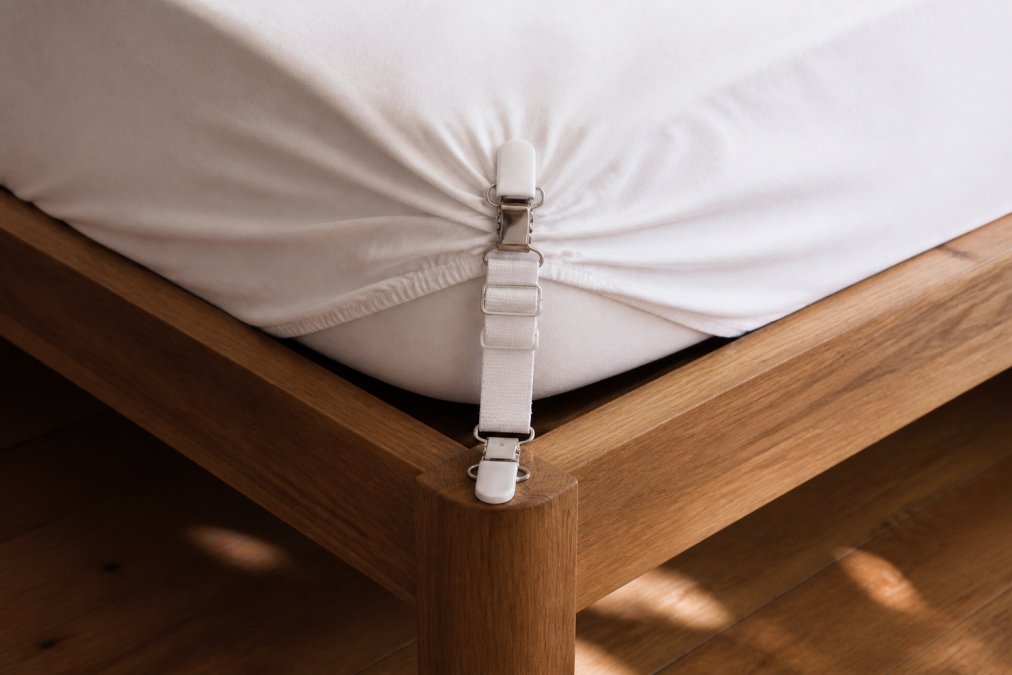
Sheet suspenders and corner clips are the fastest fix. They physically anchor your fitted sheet to the mattress frame or legs.
Organic Bamboo Cooling Sheet Set – King →
These devices work by gripping the corners of your fitted sheet and pulling them down and under the mattress. The tension keeps the sheet tight and prevents bunching.
There are two main types:
Elastic straps with clips: These wrap around the mattress legs or frame and clip to the sheet corners. They're adjustable and work on most bed frames.
Tension clips: These grip the sheet corner and the mattress simultaneously, creating direct downward tension.
Both work. Elastic straps are easier to adjust. Tension clips are more permanent. Pick whichever fits your bed frame.
Fix 5: Master the Proper Tucking Technique
The way you tuck your fitted sheet matters. Most people tuck too loosely or too tightly in the wrong spots.
Start at one corner. Pull the fitted sheet pocket over that corner firmly. Don't overstretch, just enough to secure it. Move to the next corner and repeat.
Work your way around the bed systematically. Tighten each corner evenly. Uneven tension causes bunching.
Once all four corners are secure, tuck the excess fabric under the mattress on the sides. Don't pull too hard. Let the fabric lie naturally under the mattress.
The goal is even tension across all four corners. Uneven tension creates stress points where the sheet bunches.
Proper tucking steps:
- Start at one corner of the head of the bed
- Pull the pocket over the corner firmly
- Move to the next corner (diagonal)
- Repeat until all four corners are secure
- Tuck excess fabric under the mattress sides
- Check for even tension across all corners
Fix 6: Fold and Store Sheets to Prevent Stretching
How you store your sheets affects how they fit when you put them back on the bed. Improper folding stretches the elastic and creates permanent wrinkles.
Fold fitted sheets carefully. Don't stuff them into tight spaces where they get compressed and creased.
Store sheets in a cool, dry place. Moisture and heat degrade elastic and fabric. A linen closet is ideal. Avoid plastic storage bins that trap moisture.
When you pull sheets out to use them, check the elastic. If it feels loose or stretched, that's a sign the elastic is degrading. Replace the sheets soon.
Fix 7: Invest in Quality Sheets with Durable Elastic
Not all fitted sheets are created equal. Quality matters. Cheap sheets use thin, low-grade elastic that degrades quickly. Premium sheets use thicker, higher-quality elastic that lasts years.
Look for sheets made with long-fiber bamboo viscose. The longer fibers create stronger fabric and better tension. The elastic should feel substantial when you touch it, not thin or flimsy.
Bambusasheets bamboo viscose sheet sets are crafted with a delicate sateen weave from naturally breathable bamboo fiber, offering a silky-smooth experience.
Signs of quality fitted sheets:
- Thick, substantial elastic that feels durable
- Reinforced corner pockets that don't tear easily
- Long-fiber fabric that resists pilling
Frequently Asked Questions
Why do my fitted sheets keep popping off the corners?
Fitted sheets pop off when the elastic band loses tension or when your mattress is deeper than the sheet's pocket depth. Mattress toppers add extra height, which is a common culprit. Poor tucking technique and low-quality elastic that degrades over time also contribute. Choosing sheets with pocket depth that matches your mattress, including any topper, and using corner clips can solve this problem.
How do I keep my bamboo sheets from bunching up?
Bamboo sheets resist bunching better than cotton when cared for properly. Wash them in cold water on a gentle cycle to preserve the elastic, tumble dry on low heat, and avoid high temperatures that weaken fibers. Use fitted sheet suspenders for extra security, and ensure your sheet size matches your mattress depth. Proper washing and storage prevent elastic degradation that causes bunching.
Do sheet suspenders actually work?
Yes. Fitted sheet suspenders and corner clips provide anchor points that hold sheets firmly in place, preventing slipping and bunching. They're especially effective for side sleepers who move around during the night or for thicker mattresses where standard pockets don't grip well. Suspenders work by applying tension across the sheet's corners, distributing pressure evenly rather than relying solely on elastic bands.
How can I tighten a fitted sheet that is too loose?
First, verify your sheet size matches your mattress dimensions and pocket depth. If the fit is still loose, use fitted sheet suspenders or corner clips to create additional tension. When making the bed, tuck the sheet firmly under the mattress on all sides, starting at one corner and working around. For bamboo sheets, avoid over-washing in hot water, which weakens elastic. If the elastic is permanently stretched, replacement is the best solution.