
Table of Contents
- Best Cooling Sheets for Hot Sleepers: Quick Comparison
- Why Bamboo Sheets Keep Hot Sleepers Cool
- The Best Sheet Material for Hot Sleepers: Bamboo vs Cotton vs Tencel
- Top Bamboo Sheet Picks for Hot Sleepers
- Bamboo Sheets Sateen Weave: Why the Weave Decides Cooling
- How to Wash Bamboo Sheets Without Losing Softness
- How We Tested and What to Ignore When Buying
- Conclusion: Choosing Your Bamboo Sheet Set
- Frequently Asked Questions
Last Updated: October 13, 2026
Best Cooling Sheets for Hot Sleepers: Quick Comparison
Bamboo sheets are effective cooling sheets for hot sleepers because bamboo viscose wicks moisture and lets air pass through the weave.
Here's the short version before we get into the details:
| Set | Size | Price | Best For |
|---|---|---|---|
| Navy 7-Piece | Queen | $135 | Deep color, deep pockets |
| Grey 7-Piece | King | $148 | Wrinkle-hiding neutral tone |
| Navy 7-Piece | King | $148 | Largest beds, hotel feel |
| White 7-Piece | Full | $83 | Lowest-cost entry point |
| Navy 7-Piece | Full | $88 | Full-size color without heat |
| Grey 7-Piece | Queen | $135 | Everyday luxury, all decor |
| White 7-Piece | King | $144 | Crisp hotel-white look |
| White 7-Piece | Queen | $129 | Classic white, upgraded |
| Ivory 7-Piece | Full | $83 | Warm tone, soft glow |
| Ivory 7-Piece | King | $144 | Hotel-luxury feel |
Every set includes a fitted sheet, flat sheet, four pillowcases, and a storage bag, the only differences are size, color, and price.
Why Bamboo Sheets Keep Hot Sleepers Cool
Bamboo-derived fabric earns its reputation through two mechanisms: breathability (how easily air moves through the weave) and moisture-wicking (how quickly it pulls sweat off your skin to evaporate). Bamboo viscose handles both because its fibers are smooth and round, with tiny gaps that let air circulate; cotton fibers are flatter and more irregular, so they trap heat and hold dampness.
Breathability, Airflow, and Moisture-Wicking Explained
Breathability describes how much air passes through the fabric; moisture-wicking is its ability to pull sweat off your skin and spread it so it dries faster. A sheet can feel cool at first and still trap heat an hour later, so look for airflow and moisture management claims, not just "cooling."
The Best Sheet Material for Hot Sleepers: Bamboo vs Cotton vs Tencel
Bamboo-derived fabric and Tencel lyocell are effective sheet materials for hot sleepers. Bamboo and Tencel wick and breathe well; cotton, especially high thread count, holds heat.
Here's how the three compare on the factors that matter at night:
| Material | Breathability | Moisture-Wicking | Feel | Heat Retention |
|---|---|---|---|---|
| Bamboo viscose | High | High | Silky, cool-to-touch | Low |
| Tencel lyocell | High | High | Smooth, slightly drier | Low |
| Cotton | Moderate | Moderate | Crisp, softens over time | Higher |
Both are regenerated cellulose, so they behave similarly; the practical difference is hand-feel, bamboo viscose drapes like silk, Tencel feels more matte.
Why the Fiber Chemistry Matters
All three start as cellulose, the structural polymer in plant cell walls; what changes is how it's broken down and rebuilt into fiber.
- Bamboo viscose dissolves bamboo cellulose in a chemical bath and extrudes it into round, smooth filaments that slide over skin and drape rather than stand up.
- Tencel lyocell uses a closed-loop solvent process that recovers most of the solvent; the fiber is smooth and round, but slightly denser and less glossy than bamboo viscose.
- Cotton is a natural fiber with a flattened, ribbon-like, twisted structure, more surface area and more places for moisture and heat to sit.
Reading the Label: Viscose, Rayon, Lyocell, and "Bamboo"
"Bamboo sheets" is a marketing phrase, not a fiber name. The actual fiber on the care label will be one of these:
- Bamboo viscose (sometimes "viscose" or "viscose rayon"), the most common bamboo-derived fiber. Soft, drapey, cool to the touch.
- Bamboo rayon, the FTC treats "rayon" and "viscose" as the same fiber family, so "rayon made from bamboo" describes the same viscose process.
- Lyocell, a regenerated cellulose fiber made with a closed-loop solvent process, from bamboo, eucalyptus, or other cellulose. Branded Tencel is typically eucalyptus.
"Bamboo" on a label tells you the cellulose source, not the process, weave, or cooling performance. A 100% bamboo-derived sheet can still sleep hot if woven densely.
Weave Changes the Answer More Than Fiber Does
Fiber sets the ceiling; weave sets what you feel. A sateen weave (one yarn under, three or four over) floats more yarn on the surface for a smooth, lustrous hand and freer airflow. A percale weave (one over, one under) is crisper and more matte, with a tighter grid some sleepers find cooler in humid conditions because it doesn't cling.
The Cotton Caveat
Cotton isn't automatically bad for hot sleepers. Long-staple cottons like Pima and Supima have longer fibers, fewer exposed ends, smoother surface, better airflow, so a well-made long-staple percale can sleep cooler than a cheap, densely woven bamboo sheet. The problem: most cotton sheets sold as "cooling" are high thread count sateen, which packs more yarn per square inch and reduces air space.
Quick Decision Guide
- Night sweats or hot flashes: bamboo viscose, sateen or percale, with a stated moisture-wicking finish. Prioritize wicking over cool-to-the-touch.
- Humid climate: bamboo viscose percale or a bamboo-Tencel blend, less cling, faster dry.
- Dry climate, cool hand-feel preference: bamboo viscose sateen.
Top Bamboo Sheet Picks for Hot Sleepers
The Navy Queen 7-Piece set at $135 offers breathability and moisture-wicking, plus deep pockets that stay put and embroidered corner letters that end the guessing game when making the bed half-asleep.

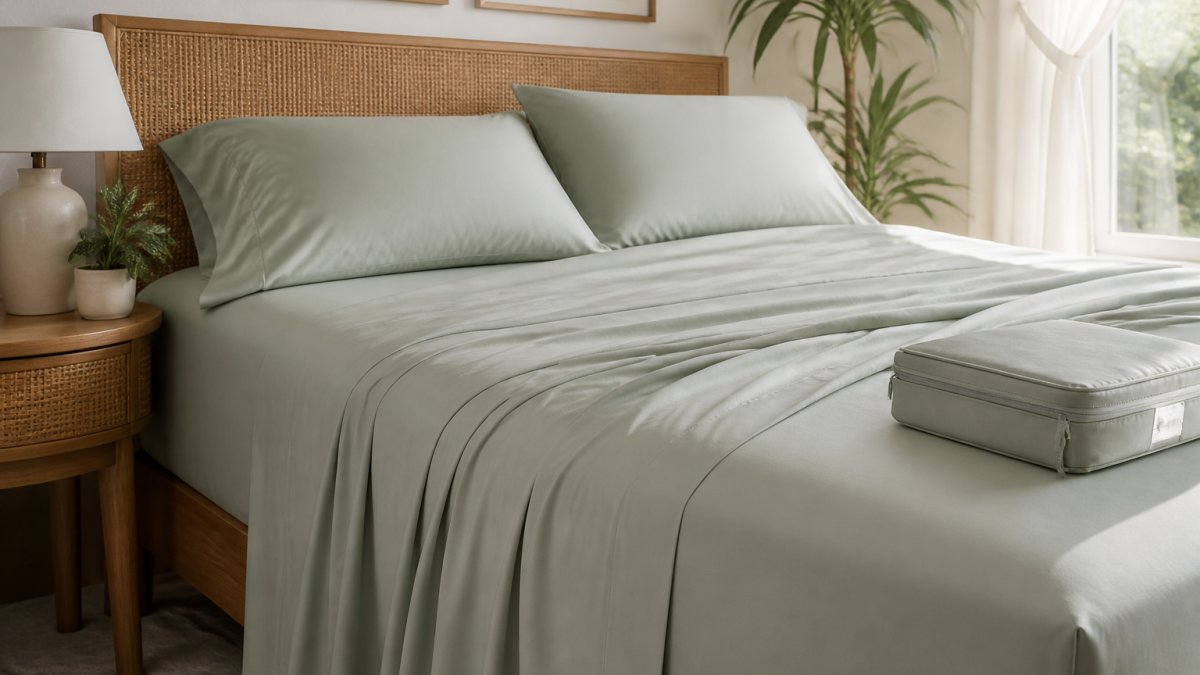
Every set below shares the same core construction: bamboo viscose, sateen weave, deep pockets, and corner size marks.
Navy Queen 7-Piece: Deep Color, Deep Pockets
The Bambusasheets Navy Queen 7-Piece set is built for hot sleepers who want color without sacrificing cooling. Rich navy hides everyday marks better than white, and the bamboo viscose breathes and wicks from the first wash.
The standout detail is the embroidered Q on the bottom corners. It tells you the size and which end goes where, so the fitted sheet never goes on sideways.
Grey King and Ivory King: The Largest Beds Covered
King sleepers get two strong options, both at $148. The Grey King 7-Piece set hides wrinkles better than white and pairs with nearly any decor.
Both include embroidered K marks on the bottom corners, extra-deep pockets that stay put on thick mattresses, and a sateen weave that resists pilling wash after wash. If you want a neutral that disappears into the room, pick grey.
Navy Cooling Bamboo Sheets - Queen - 7pc Never Goes On Backwards →
Full and Queen Sets: Best Value Entry Points
Full-size sleepers have the lowest-cost way in. The White Full 7-Piece set and the Ivory Full 7-Piece set both come in at $83, making them the cheapest route to a full bamboo set.
Queen sleepers who want to save a little can choose the White Queen 7-Piece set at $129, or the Grey Queen at $135 if you'd rather hide everyday wrinkles.
Bamboo Sheets Sateen Weave: Why the Weave Decides Cooling
Bamboo sheets sateen weave matters more than thread count for cooling. Sateen uses a one-yarn-under, three-or-four-yarn-over pattern, producing a smooth, lustrous surface with fewer raised fibers, less friction against skin and freer airflow. Thread count is a weaker signal: bamboo viscose fibers are already fine, so a high count doesn't automatically mean a cooler sheet. What you want is a tight, even weave that drapes well and resists pilling, exactly what good sateen delivers.
How to Wash Bamboo Sheets Without Losing Softness
Wash bamboo sheets in cold water on a gentle cycle and tumble dry low. Skip bleach, heat and harsh chemicals break down the long fibers that give bamboo viscose its softness and stretch.
- Wash cold on a gentle cycle with a mild detergent
- Skip fabric softener, which coats fibers and reduces wicking
- Tumble dry low, or air dry
- Remove promptly to avoid deep creases
- Rotate two sets so each gets a rest between washes
Bamboo sheets drape smoothly and resist the stiff wrinkles common in cotton, so no ironing is needed. Store each set in its storage bag.
How We Tested and What to Ignore When Buying
We evaluated each set on the factors that affect sleep, not marketing claims: fabric construction, moisture handling, fit, and long-term care. Most roundups tell you a sheet "felt cool" and leave it there, that's an impression, not a test. Here's our repeatable protocol.
The Protocol
Room conditions. Temperature and relative humidity are logged nightly with a hygrometer, because a sheet that wicks well in dry air can feel clammy in a humid room.
Cooling assessment. Testers rate the sheet 1-5 at bedtime, at the first overnight wake (typically 2-4 a.m.), and at morning wake.
Durability and ownership cost. Each set goes through 20 wash-and-dry cycles.
What to Ignore When Buying
- Thread count as a proxy for cooling. Bamboo viscose fibers are already fine, so a high thread count usually means a denser, heavier fabric that traps heat.
- "Cooling" claims with no mention of moisture management. Cool-to-the-touch is a first-minute sensation. No wicking or airflow claim means a surface treatment, not a fabric property.
- Listings that don't state the fiber type. "Bamboo blend" without the other fiber or percentages tells you nothing about how it will sleep.
How to Run a 15-Minute Version at Home
You don't need a lab to sanity-check a set before the return window closes:
- Read the care label and confirm the fiber type.
- Hold the flat sheet up to a lamp. Even light passage means the weave is open enough to breathe.
- Drop a teaspoon of water on the fitted sheet. Beading means poor wicking; spreading means good wicking.
- Tug the corners on your mattress. If it pops off with a firm pull, it will pop off at 3 a.m.
- Sleep on it at least three nights. The first night tells you hand-feel; the third tells you heat.
Conclusion: Choosing Your Bamboo Sheet Set
The right set comes down to size, color, and how you sleep, not how much you spend. A hot-sleeping Queen sleeper who wants deep color should start with the Navy Queen 7-Piece at $135. King sleepers can pick grey or ivory at $148.
Match the size to your mattress, pick a color you'll enjoy, and wash cold to protect the fibers.
Frequently Asked Questions
Are bamboo sheets good for hot sleepers?
Yes. Bamboo viscose is naturally breathable and moisture-wicking, which helps regulate body temperature through the night. Unlike cotton, which can trap heat and hold dampness against your skin, bamboo-derived fabric moves moisture away so you stay drier. For anyone dealing with night sweats or a warm bedroom, a bamboo sheet set is one of the most effective swaps you can make. Look for a sateen weave and deep pockets so the fitted sheet stays put while you sleep.
Do bamboo sheets keep you cool all night?
They help, but no sheet works alone. Bamboo sheets manage heat and sweat better than most cotton options because the fiber wicks moisture and allows airflow. In a warm climate or a room above 70°F, pair them with a fan or breathable comforter for the best results. The cooling benefit comes from continuous moisture management, not a chilled surface, so expect steady comfort rather than an instant cold feel that fades.
What weave is best for cooling bamboo sheets?
A sateen weave is the common choice for cooling bamboo sheets. It uses long fiber floats that create a smooth, silky surface with a subtle sheen and a soft drape. That smoothness reduces friction and feels cool to the touch, while the tight-but-breathable structure supports airflow. Percale is crisper and airier, but bamboo sateen gives you the softness most hot sleepers want without sacrificing breathability. Check the product listing for weave details before buying.
How do you choose bamboo sheets for hot sleepers?
Start with material, then fit, then care. Confirm the set uses bamboo viscose or lyocell rather than a cotton blend, since blends cut breathability. Check pocket depth against your mattress height, especially if you use a topper, and look for corner straps or size markers so the fitted sheet stays anchored. Finally, read the wash instructions: cold gentle cycles and low tumble dry keep the fabric soft and prevent pilling. A 7-piece set with four pillowcases usually covers a full bedding rotation.
How should you wash bamboo sheets to keep them cool and soft?
Wash in cold water on a gentle cycle and tumble dry on low heat. Skip bleach and fabric softener, which can coat the fibers and reduce moisture-wicking. Wash bamboo sheets separately from heavy items like towels to limit friction and pilling. If you can, air-dry or remove them slightly damp to preserve the sateen sheen. Following these steps keeps the fabric breathable and extends the life of the set over repeated washes.
Most hot sleepers don't need to overhaul their bedroom, just their sheets. Bambusasheets builds 7-piece bamboo viscose sets with a delicate sateen weave, naturally breathable and hypoallergenic fiber, and embroidered size indicators that make bed-making simple. Get started with Bambusasheets and wake up cooler, without the 3 a.m. sheet shuffle.