
Table of Contents
- Why Authentic Bamboo Sheets Are Hard to Spot
- Bamboo Sheet Labeling Requirements You Need to Know
- Viscose, Lyocell, and Modal: What the Fiber Name Tells You
- The Benefits of Bamboo Viscose Bedding That Signal Real Quality
- How to Verify Bamboo Sheets Before You Buy
- Bamboo Viscose vs Cotton Sheets: A Side-by-Side Comparison
- Home Tests and Physical Checks for Authentic Bamboo Sheets
- Common Mistakes When Buying Bamboo Sheets
- Frequently Asked Questions
Last Updated: October 4, 2026
Why Authentic Bamboo Sheets Are Hard to Spot
Knowing how to tell if bamboo sheets are authentic starts with one uncomfortable fact: the word "bamboo" on a label tells you very little.
The gap between marketing and reality is wide, and it's legal. Three things make it hard to spot: the fiber name and the plant name are not the same thing, "bamboo" is not a regulated fiber category, and certifications are often printed without explanation.
Bamboo Sheet Labeling Requirements You Need to Know
Labeling is where the truth lives. Under the FTC Textile Rules and Regulations, textile products sold in the United States must list fiber content by its generic name, not its marketing name. That single rule explains most of the confusion.
What the FTC Textile Rules Actually Require
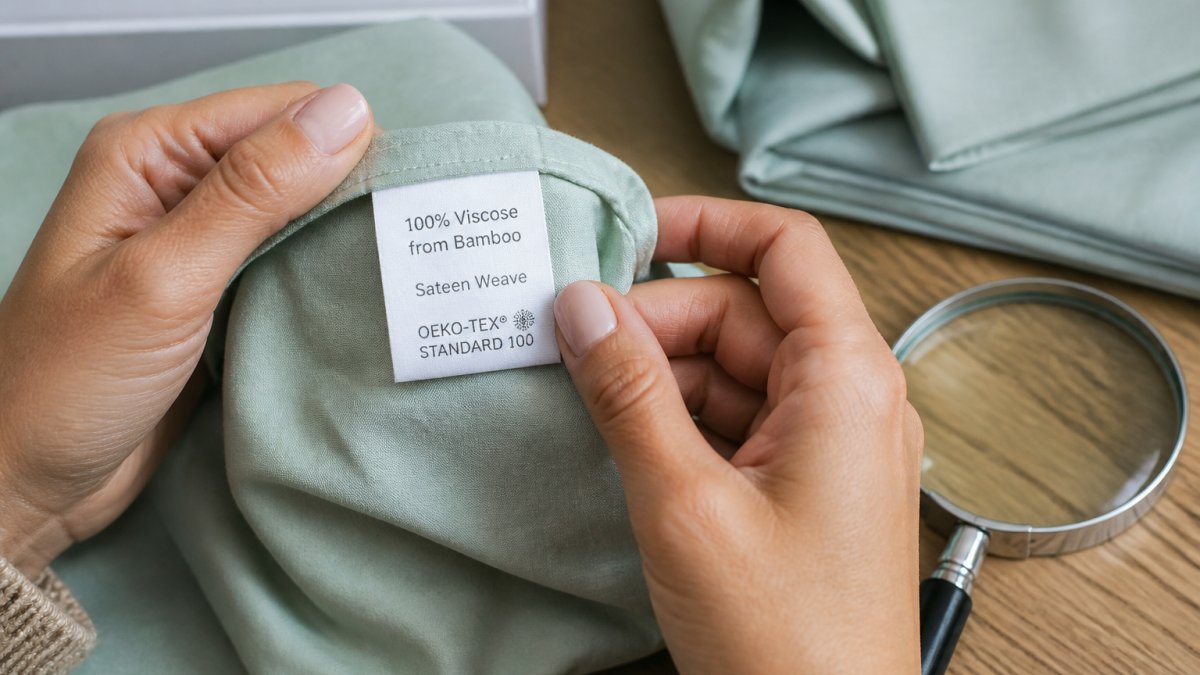
The Textile Fiber Products Identification Act requires every textile item to carry a label showing fiber content, country of origin, and the manufacturer or marketer, using generic fiber names. If the plant was chemically processed into a fiber, the correct generic name is rayon or viscose; many brands print "bamboo viscose" or "bamboo rayon" to stay compliant while keeping the plant name visible.
Why '100% Bamboo' Can Be Misleading
A label reading "100% bamboo" on a soft, silky sheet is a red flag. Mechanically crushed bamboo is rough and linen-like, not silky. Silky bamboo fabric means the fiber was regenerated, which makes it viscose or rayon under federal labeling rules.
That doesn't make it fake. It makes the label incomplete.
Viscose, Lyocell, and Modal: What the Fiber Name Tells You
The fiber name is your best clue about quality.
Viscose is the most common bamboo fiber, soft and drapey, and what most bamboo sheet sets use.
Lyocell is made in a closed-loop system that recovers most of the solvent, so it holds up better over time.
Modal is a modified viscose, usually from beech wood, known for staying smooth after many washes.
| Fiber | Source | Feel | Durability |
|---|---|---|---|
| Viscose | Bamboo pulp | Silky, cool | Moderate |
| Lyocell | Bamboo or eucalyptus | Silky, cool | Higher |
| Modal | Beech wood | Very soft | Higher |
| Cotton | Cotton boll | Crisp, breathable | High |
The Benefits of Bamboo Viscose Bedding That Signal Real Quality
Real bamboo viscose bedding earns its reputation through performance, not adjectives. When the fiber is genuine and the weave tight, you feel it on night one.
Breathability, Moisture-Wicking, and Thermal Regulation
Bamboo viscose fibers are round and smooth, letting air move through the fabric and pulling moisture away from skin. A sheet that feels cool in the store but traps heat by 2 a.m. is usually a lower-grade fiber or a loose weave.
Softness, Durability, and Pilling Resistance
Long fibers create smoother yarn, and smoother yarn pills less. Cheap bamboo viscose uses shorter fibers, which is why some sheets feel wonderful for a month and rough by month six. Look for brands that mention long-fiber construction.
How to Verify Bamboo Sheets Before You Buy
Verification comes down to two habits: reading certifications and reading the price. Both take under five minutes.
Decoding Certification Logos: OEKO-TEX, GOTS, and OCS
Most shoppers treat certification logos as decoration. They are the fastest way to verify a bamboo sheet claim, because each mark verifies a different thing, and a legitimate mark always carries a number you can look up.
OEKO-TEX Standard 100, Look for "STANDARD 100" inside the logo, plus a four-digit institute number and a certificate number beside it.
OCS (Organic Content Standard), The logo is a simple leaf-and-text mark. OCS verifies only that a stated percentage of the source material is organic.
| Certification | What it verifies | What it does NOT verify |
|---|---|---|
| OEKO-TEX Standard 100 | Finished-fabric chemical safety | Organic content, fiber source |
| GOTS | Organic fiber content + processing limits | Nothing relevant to bamboo authenticity is left out |
| OCS | Organic source-material percentage | Processing chemicals, wastewater |
Price-to-Quality Correlation: What Higher Prices Should Deliver
Bamboo viscose is not a cheap fiber to make well. The viscose process requires solvent recovery equipment, wastewater treatment, and long-fiber pulp, and those costs show up in the final price.
- Shorter fibers. Cheap pulp produces short staple fibers that pill within a few washes.
- Thinner weave. A lower thread count or looser sateen weave uses less yarn per sheet and lets more light through when held to a window.
- No chemical testing. Skipping OEKO-TEX or GOTS certification removes a real cost; the absence of a checkable certificate number is the tell.
What a higher price should buy you:
- A stated generic fiber name (viscose, lyocell, or rayon), not just "bamboo"
- At least one certification with a lookup number
- Long-fiber construction mentioned in the product specs
- Reinforced stitching and deep pockets that fit modern mattresses
If a premium price comes with a vague label and no certificate number, the premium is going to packaging and marketing, not the fiber. A mid-priced sheet with a named fiber and a verifiable OEKO-TEX number is a better authenticity bet than a luxury-priced sheet with neither.
Bamboo Viscose vs Cotton Sheets: A Side-by-Side Comparison
Bamboo viscose vs cotton sheets is a real trade-off, not a clean win for either. Bamboo viscose feels cooler and silkier; cotton is more durable and easier to care for.
| Feature | Bamboo Viscose | Cotton |
|---|---|---|
| Feel | Silky, cool | Crisp to soft |
| Breathability | High | High (percale) |
| Moisture-wicking | Strong | Moderate |
| Durability | Moderate | High |
| Care | Gentle, cold wash | Forgiving |
| Best for | Hot sleepers, sensitive skin | Heavy daily use |
For hot sleepers and anyone with sensitive skin, bamboo viscose is usually the better pick. For a guest room that sees hard use, cotton holds up longer.
Home Tests and Physical Checks for Authentic Bamboo Sheets
Two checks settle most doubts: a burn test and a close look at the weave. Both work on sheets you already own.
The Burn Test: What It Can and Cannot Tell You
Here is the safe procedure.
What you need: a few loose fibers pulled from an inside seam (never cut a hole in the sheet), a metal sink or fireproof surface, a long match or lighter, and a bowl of water.
Procedure:
- Pull 4-6 individual fibers from a seam allowance or a hem, where removal will not unravel the sheet.
- Hold the fibers with metal tweezers over a metal sink. Do not hold them with your fingers.
- Light the tip and observe the flame, the smell, and the residue.
- Drop the residue into the water bowl and let it cool before touching it.
How to read the results:
| Fiber type | Flame behavior | Smell | Residue |
|---|---|---|---|
| Cellulose (viscose, lyocell, modal, cotton) | Burns fast like paper | Burnt paper | Soft, light gray ash |
| Polyester / synthetic blend | Melts and shrinks away from flame | Chemical, sweet, or plastic | Hard black bead that will not crush |
| Blend | Burns unevenly, may self-extinguish | Mixed | Ash with hard specks |
What the burn test cannot tell you: whether the cellulose fiber came from bamboo, eucalyptus, beech, or cotton. Viscose from bamboo and viscose from wood burn identically because they are chemically the same fiber.
Visual Comparison of Weave Textures and Fiber Content
A phone camera with macro mode or a cheap clip-on macro lens is enough to see the difference.
Step 1: Backlight the fabric. Hold the sheet up to a window or a lamp.
Step 2: Identify the weave pattern.
- Sateen weave, smooth, lustrous face with more threads floating on the surface. This is the standard for quality bamboo viscose. It reflects light in a soft sheen.
- Twill weave, visible diagonal lines running across the fabric. Common in cotton, less common in bamboo viscose.
- Percale weave, matte, crisp, one-over-one pattern. Rare in bamboo viscose because the fiber is too smooth to hold a crisp hand.
Step 4: Check the cut edge. Pull a single thread from a hem and look at it against a dark surface.
Step 5: Compare against a known sample. Photograph a sheet you trust and the new one at the same macro distance and light.
Common Mistakes When Buying Bamboo Sheets
The same avoidable errors show up again and again.
- Trusting the front of the package instead of the fiber label
- Assuming "bamboo" means organic
- Buying on thread count alone, which matters less for viscose than for cotton
- Skipping the certification number check
At Bambusasheets, our 7-piece bamboo viscose sets are built around that standard: a delicate sateen weave for a lustrous, durable finish, naturally breathable and hypoallergenic bamboo fiber, and embroidered size indicators so you never guess which way the fitted sheet goes. Long, stretchy fibers keep the fit snug, and the set arrives with a storage bag.
Frequently Asked Questions
What is the downside to bamboo sheets?
The main downside is confusion around labeling. Many products labeled 'bamboo' are actually rayon or viscose made through chemical processing, not raw bamboo fiber. Some people also find bamboo viscose sheets wrinkle more than cotton blends or require gentler washing to avoid pilling. Quality varies widely, so checking fiber content and certifications like OEKO-TEX matters more than the front label. Authentic bamboo viscose bedding still offers breathability and softness, but you need to verify what you are buying.
What should I look for when buying bamboo sheets?
Check the fiber content label first. Look for terms like 'bamboo viscose,' 'bamboo lyocell,' or 'bamboo rayon' rather than vague 'bamboo' claims. Verify certifications such as OEKO-TEX Standard 100, GOTS, or OCS. Feel for a sateen or twill weave that feels smooth and cool. Ask about thread count and long-fiber construction, which reduce pilling and shrinkage. Reputable brands list full fiber content and certification details on the packaging or website.
What does the FTC require for bamboo textile labeling?
The FTC requires that textile products list fiber content by generic name. If a product is made from bamboo that has been chemically processed into rayon or viscose, it must be labeled as 'rayon' or 'viscose,' not simply 'bamboo.' The FTC has warned that calling such products 'bamboo' without qualification misleads consumers. Labels must also disclose country of origin and care instructions. This rule helps you distinguish between actual bamboo fiber and processed bamboo pulp.
Is there a test to verify bamboo fabric authenticity?
A home burn test can help distinguish plant-based fibers from synthetic ones. Bamboo viscose burns like paper, with a light ash and no melting. Synthetic fibers like polyester melt and form hard beads. However, a burn test cannot tell you whether the fiber is bamboo viscose or cotton viscose because both burn similarly. The most reliable verification is a laboratory fiber analysis, but for everyday buying, checking labels and certifications is the practical approach.
Most shoppers never learn to read a fiber label, and that's exactly why vague "bamboo" claims keep selling. The fix is simple: check the generic fiber name, look up the certification number, and feel the weave. Bambusasheets makes that easy with honestly labeled bamboo viscose sheets in a sateen weave, hypoallergenic fiber, and embroidered size indicators that take the guesswork out of making the bed. Get started with Bambusasheets and sleep on bedding you can actually verify.