
Table of Contents
- Why Bamboo Sheets Aren't as Perfect as the Marketing Says
- The Manufacturing Reality: From Bamboo Plant to Viscose Fabric
- Bamboo Sheet Durability: Where They Fall Short Over Time
- Bamboo Viscose vs Cotton Sheets: The Trade-Offs You Need to Know
- How to Wash Bamboo Sheets Without Ruining Them
- Greenwashing in Bamboo Bedding: What 'Eco-Friendly' Really Means
- Who Should Skip Bamboo Sheets (and What to Buy Instead)
- Frequently Asked Questions
Last Updated: October 2, 2026
Why Bamboo Sheets Aren't as Perfect as the Marketing Says
Bamboo sheets have a reputation problem in both directions: marketing calls them an eco-miracle fabric, skeptics call the category greenwashed rayon. The truth sits in the middle.
We sell bamboo viscose bedding and still think you deserve the unvarnished version. Bamboo sheets are soft and breathable, but they are made through a chemical-heavy process, can pill and shrink if washed carelessly, and the word "bamboo" on a label tells you almost nothing about how the fabric was made.
So what is the downside to bamboo sheets? The drawbacks cluster around three things: how the fiber is manufactured, how it holds up over years of washing, and how loosely the sustainability language is regulated.
The Manufacturing Reality: From Bamboo Plant to Viscose Fabric
Bamboo viscose is a regenerated cellulose fiber, meaning the bamboo plant is chemically dissolved and reconstituted into fiber rather than spun directly like cotton or linen. That single fact explains most of the downsides people complain about.
The plant grows fast and needs little water or pesticide, which is where the eco story starts. But the plant is not the fabric: turning stiff bamboo stalks into silky sheets requires an industrial process, and that process is where the trade-offs begin.
Chemical Solvents and Carbon Disulfide in the Viscose Process
The dominant method for making bamboo viscose uses a solvent called carbon disulfide.
Carbon disulfide exposure has been linked to neurological effects in textile workers, and the viscose industry has historically had a poor safety record in regions with weak enforcement.
Residue testing on finished fabric generally shows solvent levels well below any threshold of concern for consumers. The exposure problem is a factory-floor issue, not a bedroom issue.
Closed-Loop vs. Open-Loop: What the Label Doesn't Tell You
A closed-loop viscose process captures and reuses the solvent; an open-loop process releases most of it into the air or water. The finished sheets feel identical.
You cannot tell the difference by touch, and most bedding labels do not say which process was used. OEKO-TEX tests the finished product for harmful substances, while FSC covers forestry sourcing, neither guarantees a closed-loop mill.
Bamboo Sheet Durability: Where They Fall Short Over Time
Bamboo viscose fibers are shorter and finer than long-staple cotton, and that structure has a durability cost. The sheets feel incredible on day one. The question is what they feel like after a year of weekly washes.
The main issues are pilling, shrinkage, and a gradual loss of that initial silky hand-feel, far more likely with cheap blends and rough laundering habits.
Pilling, Shrinkage, and Texture Changes After Repeated Washing
Pilling happens when short fibers work loose and tangle into little balls on the surface. Bamboo viscose is more prone to this than long-staple cotton because shorter fibers escape the yarn more easily under friction.
Shrinkage is the second common complaint. Viscose is a regenerated cellulose fiber with high moisture absorbency, so it swells and contracts during washing and drying.
Texture degradation is subtler: over many wash cycles the sateen weave can flatten and the fabric loses some drape.
What Actually Happens After 50+ Washes
Most reviews evaluate bamboo sheets in their first month. The more useful question is what happens after roughly 50 wash cycles. Based on fiber mechanics and long-term owner reports, here is the realistic trajectory:
- Washes 1-10: Minimal visible change. The sateen sheen may soften slightly.
- Washes 10-30: Early pilling appears in high-friction zones, where feet, elbows, and the fitted sheet's corners rub. Shrinkage from hot-water exposure becomes permanent.
- Washes 30-50: Surface texture roughens in friction zones. The silky hand-feel persists in low-contact areas but overall drape flattens. Pilling may spread if washed with towels or abrasive items.
- Washes 50+: A well-made long-fiber set typically remains usable and comfortable, though visibly less lustrous. A short-fiber budget set often shows significant pilling, thinning at stress points, and a coarser surface.
The practical takeaway: fiber length is the single best predictor of how a bamboo sheet ages. Long-fiber viscose resists pilling because fewer short fiber ends escape the yarn. If a brand does not disclose fiber length, assume the shorter end of the range.
How to Evaluate Fiber Length Before You Buy
Fiber length is rarely printed on a label, but you can infer it from a few signals:
- Fabric weight (GSM): Heavier bamboo viscose fabrics generally use longer fibers and denser weaves. Very lightweight sheets at a low price point are a red flag for short-fiber content.
- Weave type: A sateen weave (four-over-one-under) feels silkier but shows pilling faster than percale or twill. Sateen is not inherently bad, it just demands gentler care.
- Brand transparency: Brands that invest in long-fiber viscose tend to state it, because it costs more. Silence on fiber length is a signal.
- Price floor: Extremely cheap bamboo sheet sets are almost always short-fiber.
Bamboo Viscose vs Cotton Sheets: The Trade-Offs You Need to Know
Neither fabric wins across the board. The right choice depends on which properties you weight most heavily.
| Factor | Bamboo Viscose | Cotton (Long-Staple) |
|---|---|---|
| Initial softness | Very high, silky | High, crisp then softens |
| Moisture-wicking | Excellent | Good |
| Thermoregulation | Strong, stays cool | Moderate |
| Durability | Moderate, prone to pilling | High, especially long-staple |
| Shrinkage risk | Higher | Lower |
| Care demands | Gentle, cold wash | Forgiving |
| Environmental profile | Depends on mill process | Depends on water and pesticide use |
The pattern is clear. Bamboo viscose wins on feel and temperature regulation; cotton wins on longevity and low-maintenance care. If you want sheets you can wash on hot and forget about, cotton is the safer bet. If you sleep hot or have sensitive skin, the comfort edge of bamboo viscose is hard to give up, it wicks moisture away from the body and feels cool against the skin.
How to Wash Bamboo Sheets Without Ruining Them
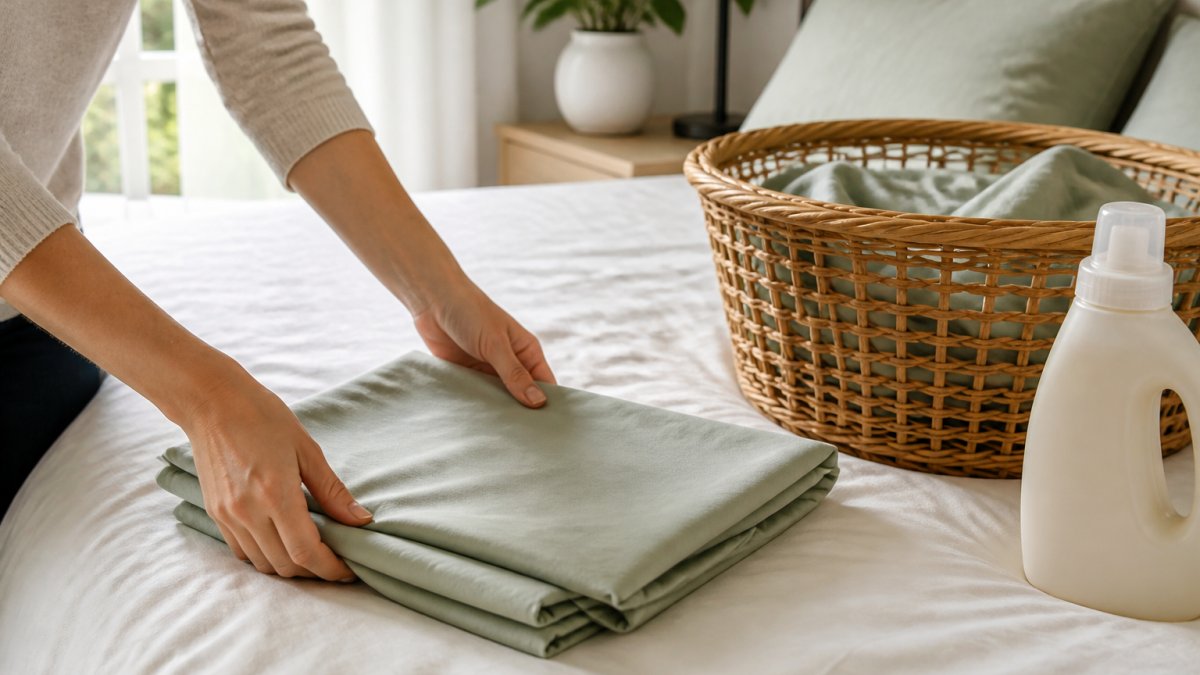
Wash bamboo sheets in cold water on a gentle cycle, then tumble dry on low or air dry. That single routine prevents most of the pilling and shrinkage people blame on the fabric itself.
A practical routine:
- Wash separately from towels, zippers, and anything abrasive
- Use a mild liquid detergent, not powder
- Skip fabric softener, which coats the fibers and reduces breathability
- Dry on low heat and remove promptly, or line dry
- Never bleach, and never wash on hot
Most bamboo sheet damage traces back to heat and friction, not to the fiber being inherently fragile. Treat them like a delicate and they hold their softness far longer.
Washing bamboo sheets in hot water or drying them on high heat is the fastest way to shrink them and set in pilling. Once the fibers mat, no amount of fabric softener brings the original texture back.
Greenwashing in Bamboo Bedding: What 'Eco-Friendly' Really Means
The word "bamboo" on a package sells sheets, and that is precisely the problem. A label can say "bamboo" while the fabric is a chemically processed viscose with an open-loop footprint that looks nothing like the plant on the tag.
The core issue is that "bamboo" describes the raw material, not the process. Two sheets can both say "100% bamboo viscose" and have wildly different environmental profiles depending on the mill, the solvent recovery, and the energy source.
What Each Certification Actually Verifies
Certifications help, but they are not interchangeable. Each covers a different slice of the supply chain, and knowing which slice matters to you is the difference between a meaningful claim and a decorative logo.
- OEKO-TEX Standard 100: Tests the finished product for harmful substance residues, things like formaldehyde, heavy metals, and certain azo dyes (OEKO-TEX® STANDARD 100). It says nothing about how the fiber was produced or whether the mill is closed-loop. A sheet can be OEKO-TEX certified and still come from an open-loop factory.
- OEKO-TEX STeP or Made in Green: Goes further, assessing the production facility for environmental management and social responsibility. Less common on bedding labels than Standard 100.
- FSC (Forest Stewardship Council): Verifies that the bamboo was sourced from responsibly managed forests. It is a sourcing certification, not a processing one. FSC-certified bamboo can still be turned into viscose in an open-loop mill.
- USDA Certified Biobased: Confirms the product contains a verified percentage of biobased content. It does not address chemical processing or solvent recovery.
- Global Organic Textile Standard (GOTS): Applies to organic fiber production and processing. Bamboo viscose is rarely GOTS-certified because the viscose process itself is chemical, not organic.
None of these certifications independently guarantees a closed-loop viscose process. That is the gap most relevant to the environmental footprint, and it is the one consumers can least easily verify.
The Residue Question: What Testing Actually Shows
A common fear is that bamboo sheets harbor chemical residue from the viscose process. The evidence on finished fabric is reassuring: independent testing of finished viscose textiles generally shows solvent residues, including carbon disulfide, at levels well below any threshold of concern for consumer contact.
If residue testing is a priority, OEKO-TEX Standard 100 is the most direct verification available on a consumer label, not a perfect proxy for ethical manufacturing, but the closest thing to an objective, third-party check on the finished fabric.
How to Read a Sustainability Claim
A useful filter is to ask what the claim is about:
- "Made from bamboo", describes the raw material only. Tells you nothing about processing.
- "OEKO-TEX certified", describes finished-product safety. Tells you nothing about the mill.
- "FSC-certified bamboo", describes sourcing. Tells you nothing about solvent recovery.
- "Closed-loop production", describes the manufacturing process. This is the claim that actually addresses the environmental footprint, and it is the one brands rarely make unless it is true, because closed-loop systems cost more to run.
"Bamboo" tells you the plant, not the process. If a brand's sustainability claim stops at the word bamboo, or at a single certification logo, it has told you nothing about how the fiber was actually made. The claim worth trusting is the specific one: which mill, which process, which certification, covering which part of the supply chain.
Who Should Skip Bamboo Sheets (and What to Buy Instead)
Bamboo sheets are not for everyone.
Skip bamboo viscose if you:
- Want sheets you can wash on hot without a second thought
- Prioritize maximum durability over maximum softness
- Have a tight budget and cannot afford a well-made long-fiber set
- Prefer a crisp, cool cotton feel over a silky drape
For those buyers, long-staple cotton or a linen blend is the more sensible choice. Both tolerate rougher care and hold up longer under frequent washing.
That is where Bambusasheets fits. Our 7-piece bamboo viscose sets use long fibers and a delicate sateen weave, which is the combination that resists pilling better than short-fiber budget sheets.
Bamboo sheets have real downsides: a chemical-heavy manufacturing process, a tendency to pill and shrink without careful washing, and a sustainability story often thinner than the label suggests.
Frequently Asked Questions
Do bamboo sheets require special care during washing?
Yes. Bamboo viscose sheets need cold water on a gentle cycle with mild detergent. Skip fabric softeners and bleach, which break down the fibers. Tumble dry on low or air dry to prevent shrinkage. Following these laundering instructions extends the life of your bamboo sheets and reduces pilling.
How do bamboo sheets compare to cotton in terms of durability?
Bamboo sheet durability depends on fiber length and weave quality. Long-fiber bamboo viscose holds up well with proper care, but lower-quality short-fiber versions pill and thin out faster than long-staple cotton. With cold washing and low-heat drying, quality bamboo sheets can last two to three years of regular use.
Can bamboo sheets cause skin irritation or allergies?
Reactions are rare but possible. Some people are sensitive to chemical residues left from the viscose manufacturing process, particularly carbon disulfide traces in lower-quality sheets. Look for OEKO-TEX certified bamboo sheets, which are tested for harmful substances. If you have sensitive skin, wash new sheets before first use to remove any residual processing agents.
Why do some bamboo sheets feel thinner than others?
Fiber length and weave density determine how substantial bamboo sheets feel. Cheaper sheets use shorter fibers that require more processing and produce a thinner fabric prone to pilling. Long-fiber bamboo viscose with a tighter sateen weave creates a denser, more durable sheet that maintains its softness and tensile strength through repeated laundering.